|
Translate:
       
Animal Info - Addax
(Other Names: 弓角羚,
弓角羚羊,
アダックス, Abu-Akach,
Addax à Nez Tacheté, Akash, Anjidohl, Antilope Addax, Antilope Blanche,
Antilope de Mendès, Auel, Bakra el onash,, Begaar
el Ouach, Mendesantilope, Tamita)
Addax nasomaculatus
Status: Critically
Endangered
Contents
1. Profile (Picture)
2. Tidbits
3. Status and Trends (IUCN Status, Countries Where
Currently Found, Population Estimates, History of Distribution, Threats and Reasons
for Decline)
4. Data on Biology and Ecology (Size
and Weight, Habitat, Age to Maturity, Gestation
Period, Birth Season, Birth Rate, Maximum Age, Diet, Behavior,
Social Organization)
5. References
Profile
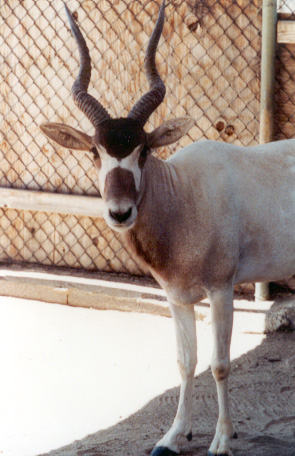
Pictures: Addax #1
(18 Kb JPEG) (Fossil Rim Wildlife Center); Addax
#2 (75 Kb JPEG)
The addax is gray-brown in winter and sandy to white in summer, with long,
thin, spiral horns that slant back and upward. It stands about 1.1 m (3.5') at
the shoulder and has large splayed hooves for walking in soft sand. It is the most desert-adapted of antelopes, being well adapted to heat, a diet
of coarse grasses and the absence of water. It lives most of its life without drinking,
deriving sufficient moisture from dew and the plants on which it feeds. The addax weighs
up to 135 kg (300 lb). It is found in sandy and stony regions of the Sahara Desert,
particularly dune regions. When grasses are absent, it browses acacia species and
leguminous herbs. Because of the extreme aridity of its habitat, the addax moves over
considerable distances in search of food. It is principally nocturnal and crepuscular
and rests during the heat of the day. Currently it only occurs singly or in groups of up to 4.
Addax once occurred throughout the deserts and sub-deserts of North
Africa from the Atlantic to the Nile.
However, by the late 1800's this range was already shrinking. By 1972, the addax was found
mainly in Rio de Oro, Mauritania; North Mali and Chad; with
some in Algeria, South Libya, and North Sudan.
It was rare everywhere except in the uninhabited area in Mauritania and Mali
in the western Sahara. The only known remaining population of the addax is in
the Termit/Tin Toumma region of Niger.
There are sporadic records of small isolated groups and individuals from the
Eastern Air Mountains/Western Ténéré desert in Niger,
and from the Equey region of western Chad.
The decline of the addax has been caused mainly because of motorized hunting with modern weapons by
indigenous people who sought meat and leather. The expansion of pastoral agriculture,
prolonged drought, harassment by desert travelers, mining
exploration, and in some areas tourists, have also
been factors.
Tidbits
*** The addax is one of the world's rarest mammals.
*** Prevailing attitudes in the 1960's are reflected in the comment, regarding Sudan, that "All game was looked upon as a free
source of fresh meat and skins, and any animal - irrespective of sex or condition - would
be ruthlessly killed." (IUCN 1969)
*** The addax can survive in waterless areas of the Sahara Desert.
*** Probably the only reason that the addax has been able to survive at all is that it
is able to live under extremely harsh conditions, including extensive areas of sand dunes,
where hunters in vehicles are unable to enter.
*** Horns of female addax are as long as those of the males.
*** Captive breeding has produced a world captive population that currently
numbers more than 860, including herds that have been established in fenced
enclosures in Tunisia, Morocco and Libya (Mallon
& Kingswood 2001).
Status and Trends
- 1960's - 1970's: Vulnerable
- 1980's - 1994:
Endangered
- 1996 - 2006: Critically
Endangered; (Criteria: A2cd) (Population Trend: Decreasing)
(IUCN
2006)
Countries Where the Addax Is Currently Found in the
Wild:
2006: Occurs in Chad
and Niger. May occur in Mali and Mauritania.
May be extinct in Sudan. (IUCN
2006)
Population Estimates:
[Note: Figures given are for wild populations only.]
History of Distribution:
Addax once occurred throughout the deserts and sub-deserts of North
Africa from the Atlantic to the Nile. At the end of the 19th century, the range of the addax extended some 8 million sq km (3
million sq mi) over most of the Sahara and the surrounding arid areas, from Mauritania in the west to Sudan in the east. Addax herds followed the rains into
southern Algeria, Libya and Egypt.
However, by the late 1800's this range had already been shrinking. By 1972, the addax was found
mainly in Rio de Oro, Mauritania; North Mali and Chad; with
some in Algeria, South Libya, and North Sudan.
It was rare everywhere except in the uninhabited area in Mauritania and Mali
in the western Sahara.
The addax is estimated to have experienced a severe decline that exceeded
80% over ten years. The only known remaining population of the addax is in the
Termit/Tin Toumma region of Niger. There
are sporadic records of small isolated groups and individuals from the Eastern
Air Mountains/Western Ténéré desert in Niger,
and from the Equey region of western Chad.
There also are continued rumors of addax along the Mali/Mauritania border (Majabat Al Koubra),
but there have been no confirmed sightings for several years. Ground and aerial
surveys of Termit/Tin Toumma carried out in 2004 indicate a population of 1-200.
A total count carried out in October 2004 indicated a figure of 128 addax for a
little under 10,000 sq km (4000 sq mi) of prime habitat in Termit, Niger.
Otherwise, the addax is assumed to have a highly fragmented distribution based
on sightings of individuals and small groups. (IUCN
2006)
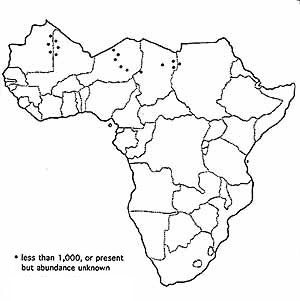
Distribution Map
(16 Kb GIF) (African Mammals
Databank 2004)
Distribution
Map (18 Kb JPEG) (AZA
Antelope TAG)
Threats and Reasons for Decline:
The addax declined mainly because of motorized hunting with modern weapons by
indigenous people who sought meat and leather. The expansion of pastoral agriculture, prolonged drought, harassment by desert travelers, mining
exploration, and in some areas tourists, have also
been factors.
The addax continues to be threatened by uncontrolled illegal hunting and
harassment. All antelope species in the Sahelo-Sahara
zone are relentlessly hunted. Long-term drought and loss of pasture are
additional threats. (IUCN
2006)
Data on Biology and Ecology
The addax stands about 1.1 m (3.5') at the shoulder. It weighs 60 - 135 kg (130 - 300 lb).
Habitat:
The addax prefers sandy and stony regions of the Sahara Desert, particularly dune
regions. During drought it enters the
grassy and shrubby formations of the northern Sahel. It can survive
in waterless areas.
Age to Maturity:
Addax attain sexual
maturity by 2 years of age (Mallon
& Kingswood 2001).
About 300 days (Mallon
& Kingswood 2001).
Birth Season:
Births usually takes place from September to January, in the period following the rainy season and
before the cold season (East
1990).
Birth Rate:
One calf is normally born per year (East
1990).
Maximum Age:
At least 25 years (captivity).
Diet:
The addax prefers to graze on coarse desert grasses in interdunal
depressions. When grasses are absent it browses
acacia species and leguminous herbs.
Behavior:
The addax is the most desert-adapted of antelopes, being well adapted to heat, a diet
of coarse grasses and the absence of water. It lives most of its life without drinking,
deriving sufficient moisture from dew and the plants that it feeds upon. Because of the
extreme aridity of its habitat, the addax moves over considerable distances in search of
food. Enlarged hooves help it to travel over sandy desert soils. It is principally nocturnal and crepuscular
and rests during the heat of the day.
Unlike in the southern Sahara, where addax migrate northward into the Sahara
during the rainy season and southward toward the Sahel in the dry season,
movements of addax in the northern Sahara, where the climate is continental rather
than tropical, have not been seasonally predictable (Mallon
& Kingswood 2001).
Social Organization:
Addax now occur singly or in groups of up to 4 (East
1990). They formerly lived in herds of 5-20 individuals, led by an old male.
Further in the past, these herds
joined to form larger groups of hundreds, even up to 1000 animals or more. Groups usually
included males and females.
Female addax dissociate from the herd a few days prior to birth of a calf and are
typically accompanied by an adult male, which remains with the female and calf
for some time after birth. Then they re-associate with the herd. (Mallon
& Kingswood 2001)
References
African Mammals Databank
2004,
AZA
Antelope TAG, Beudels-Jamar
et al. 1998, Burnie & Wilson
2001, Burton & Pearson 1987, Curry-Lindahl 1972, East
1990, Fossil Rim Wildlife Center 2000,
IUCN
1969, IUCN 1994, IUCN
1996, IUCN 2000, IUCN
2003a, IUCN
2004, IUCN 2006,
Kingdon 1997, Macdonald
1984, Mallon &
Kingswood 2001, Newby 1980, Nowak & Paradiso 1983, Oryx 1970, Oryx
1987, Oryx 1988, Stuart & Stuart 1996, Talbot 1960
Top of Page | Search
This Site
Home | Rarest
Mammals | Species Index | Species Groups Index | Country
Index | Links
Last modified: February 13, 2007;
|