|
|

|
|
|
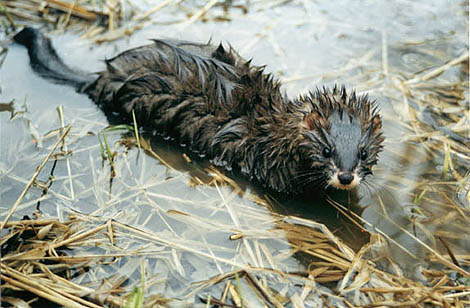
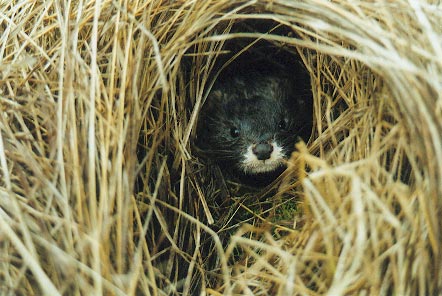
Animal Info - European MinkMustela lutreolaStatus: EndangeredContents1. Profile (Picture) ProfilePictures: European Mink #1 (38 Kb JPEG) and European Mink #2 (42 Kb JPEG) (Belarus Natl. Acad. Sci.); European Mink #3 (19 Kb JPEG) (Univ. Tartu) The European mink is smaller than its American relative, weighing up to 740 g (1.6 lb). It inhabits the densely vegetated banks of creeks, rivers and lakes. Its diet includes small mammals, frogs, molluscs, crabs, fish and insects. All mink species are mainly crepuscular and nocturnal. They are semiaquatic and swim and dive well. Their partly webbed feet are useful for hunting underwater. Mink species are solitary and territorial. A mink may excavate its own burrow, take one from a water vole or establish a den in a sheltered location. The female usually has 4 or 5 young per litter. A century ago the European mink could be found throughout the European continent. It has declined due to hunting, habitat loss, water pollution and competition with the American mink, which was introduced into Europe in 1926 for fur farming. Currently, it is declining rapidly in Eastern Europe and probably exists in small populations in Spain and France. Tidbits*** Male American mink can mate with female European mink earlier than can males of the same species. The embryos are always resorbed before birth, but it means that the European mink females are unable to breed. (Oryx 1991) Status and TrendsIUCN Status:
Countries Where the European Mink Is Currently Found:2004: Occurs in Belarus, France, Kazakhstan, Romania, Russia, and Spain. It may occur in Greece and the Ukraine. (IUCN 2004) Population Estimates:
History of Distribution:A century ago the European mink could be found throughout the European continent. By the middle 1970's, it occurred in the Soviet Union, Finland, eastern Poland, parts of the Balkans, Spain and western France. Currently, it is declining rapidly in Eastern Europe and probably exists in small populations in Spain and France. It is now extinct or greatly reduced over most of its former range (IUCN 2004). Distribution Map (light area: past distribution; dark area: present distribution) (33 Kb JPEG) (Spec. Cons. Found.) Threats and Reasons for Decline:Reasons for its decline include hunting, habitat loss, water pollution and competition with the American mink, which was introduced into Europe in 1926 for fur farming. Competitive exclusion of the European mink by the American mink has been observed within 5 - 10 years on the upper Lovat River, a medium-sized river in Russia (Sidorovich, V.E. et al. 1995). Data on Biology and EcologyWeight:
Habitat:
Age to Maturity:
Gestation Period:
Birth Season:
Birth Rate:
Early Development:
Dispersal:
Maximum Age:
Diet:
Behavior:
Social Organization:
Density and Range:
ReferencesBelarus Natl. Acad. Sci., Burton & Pearson 1987, Cons. Intl. 2005, IUCN 1994, IUCN 1996, IUCN 2000, IUCN 2003a, IUCN 2004, Macdonald 1984, Nowak & Paradiso 1983, Oryx 1991, Schreiber et al. 1989, Sidorovich, V.E. et al. 1995, Spec. Cons. Found., Univ. Tartu, Valicenti 1997 Top of Page | Search This Site Home | Rarest Mammals | Species Index | Species Groups Index | Country Index | Links Last modified: March 11, 2005; |
|
© 1999 - 2019
Animal
Info. Endangered animals of the
world.
Contact Us.. |