|
|
|
|
|
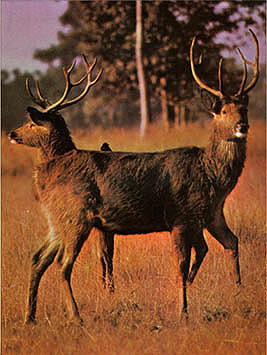
Animal Info - Barasingha(Other Names: 印度沼鹿, 沼鹿, バラシンガジカ, Barasinga, Cerf de Duvaucel, Ciervo de Duvaucel, Gond, Swamp Deer)Cervus duvauceliiStatus: VulnerableContents1. Profile (Picture) ProfilePictures: Barasingha #1 (52 Kb JPEG) (Czech Web Site); Barasingha #2 (33 Kb JPEG) (Les Cerfs) The barasingha weighs 170 - 180 kg (370 - 400 lb). It occurs in a wide range of habitats, especially preferring marshes, where it can be highly aquatic, and grassy areas close to water. It also occurs in a variety of forest types. It eats mainly grasses. The barasingha can be active during the day or at night. It associates in mixed herds of males and females for most of the year, averaging about 10 - 20 animals in a herd. The barasingha was formerly located in suitable localities throughout the basins of the
Indus, Ganges and Brahmaputra Rivers as well as central India.
Its population has declined significantly. Currently, it is restricted to India and Nepal
in a northern population in the terai of Uttar
Pradesh and adjoining Nepal and Assam, as well as a
southern population in Madhya Pradesh. Tidbits*** "The sight or smell of a tiger appears to arouse the curiosity of the barasingha... On one occasion a tigress with 4 cubs rested in a thicket after a meal. Seven stags passed by and scented the tigers, then milled around at the edge of the thicket barking sporadically. One yearling stag entered the undergrowth for a distance of about 5', as if attempting to obtain a better view in the high grass..." (Schaller 1967) *** There are 3 subspecies of the barasingha (Cervus duvauceli). They are (with the countries where they exist or have existed): Cervus duvauceli duvauceli (wetland barasingha) (India, Nepal); C. d. branderi (upland barasingha) (currently a single population in Madhya Pradesh, India); C. d. ranjitsinhi (currently a single population in Assam, northeast India, Bangladesh (extinct)). (Wemmer et al. 1998) *** "The common belief among wildlife conservationists is that the last stronghold of C. d. duvauceli in Uttar Pradesh is Dudhwa National Park and its adjoining Kishanpur and Katerniaghat wildlife sanctuaries. However, there are areas along the Ganga that support good populations of barasingha but are badly neglected by wildlife managers. One such area is the Hastinapur Wildlife Sanctuary where barasingha exist but little is known about this population..." (Khan 1999) Status and TrendsIUCN Status:Countries Where the Barasingha Is Currently Found:2004: Occurs in India and Nepal (IUCN 2004). Population Estimates:
History of Distribution:The barasingha was formerly located in suitable localities throughout the basins of the Indus, Ganges and Brahmaputra Rivers as well as central India as far south as the Godavari River, generally in areas covered by moist, deciduous forests. In the 19th century it occurred along the base of the Himalayas from Upper Assam, in a few places in the Indo-Gangetic plain from the Eastern Sundarbans to Bahawalpur to Rohri in Upper Sind, and locally throughout the area between the Ganges and Godavari as far east as Mandla. In the early 20th century it was found primarily in the marshes bordering the Himalayas and along some of the rivers in the Gangetic basin; in Assam, India it was common in the Brahmaputra River valley; in central India, it was found in scattered pockets mostly south of the Narmada River in what is now the state of Madhya Pradesh. By the middle 1960's, populations were small and isolated and declining rapidly. At that time it was found in greatest concentration in Uttar Pradesh and the adjoining area of southwest Nepal; scattered small herds also occurred in northern Bengal, Assam and Madhya Pradesh. Currently it is found in several localities in the terai of southern Nepal and adjacent districts of India, and in Assam and Madhya Pradesh, India (Wemmer et al. 1998). Distribution Map (5 Kb GIF) (Huffman 2004) Threats and Reasons for Decline:The causes of the barasingha's decline and present threats include destruction or modification of its habitat for wetland reclamation, grass and timber cutting, illegal gathering of fuelwood and other resources in reserves, and cultivation or tree plantations; poaching; and shooting for (allegedly) crop protection. Diseases introduced by cattle may also have been a factor. Data on Biology and EcologyWeight:
Habitat:
Age to Maturity:
Gestation Period:
Birth Season:
Birth Rate:
Maximum Age:
Diet:
Behavior:
Social Organization:
Age and Gender Distribution:
Density and Range:
ReferencesBurton & Pearson 1987, Caughley & Gunn 1996, Coe 1979, Cons. Intl., Curry-Lindahl 1972, Czech Web Site, Henshaw 1994, Huffman 2004, Holloway 1973, IUCN 1969, IUCN 1994, IUCN 1996, IUCN 2000, IUCN 2003a, IUCN 2004, Khan 1999, Les Cerfs, Macdonald 1984, Nowak 1999, Nowak & Paradiso 1983, Olson & Dinerstein 1998, Olson & Dinerstein 1999, Oryx 1973c, Oryx 1978c, Schaller 1967, Wemmer et al. 1998 Top of Page | Search This Site Home | Rarest Mammals | Species Index | Species Groups Index | Country Index | Links Last modified: January 10, 2005; |
|
© 1999 - 2019
Animal
Info. Endangered animals of the
world.
Contact Us.. |