|
|

|
|
|
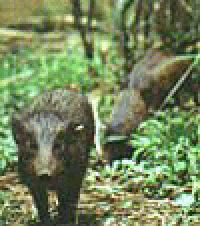
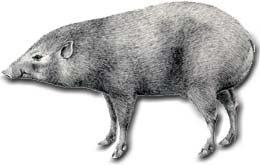
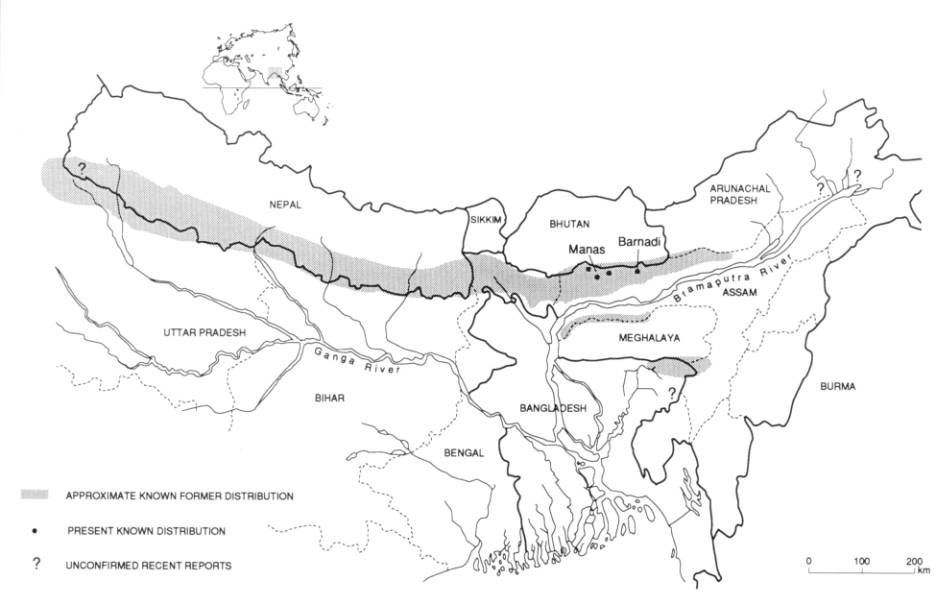
Animal Info - Pygmy Hog(Other Names: Jabalí Enano, Jabalí Pigmeo, Sanglier Nain, Sanglier Pygmée)Sus salvanius (Porcula salvania)Status: Critically EndangeredContents1. Profile (Picture) ProfilePictures: Pygmy Hog #1 (14 Kb JPEG); Pygmy Hog #2 (15 Kb JPEG) The pygmy hog is a small wild pig weighing about 8.5 kg (10 lb). It lives in dense, tall grassland, where it feeds on roots, tubers and other vegetable matter, as well as insects and other invertebrates. Nests are built and used by both sexes at all times of the year. The pygmy hog is apparently non-territorial. It lives in small family groups of about 4 - 5 individuals, comprised of one or more adult females and accompanying juveniles, and occasionally an adult male. The pygmy hog formerly occurred throughout the terai
region of India, Bhutan
and Nepal. It is now found only in northwest Assam, India. By 1993 it was reduced to only two known,
isolated populations in northwest Assam - the Manas Wildlife Sanctuary and the Barnadi
Wildlife Sanctuary. Tidbits*** The pygmy hog is the world's smallest pig. *** The pygmy hog's nervous behavior and rapid movements may be explained by its lack of any defensive weapons, such as the wild boar's tusks. Status and TrendsIUCN Status:Countries Where the Pygmy Hog Is Currently Found:2004: Occurs in India. May have become extinct in Bhutan and Nepal. (IUCN 2004) Population Estimates:
History of Distribution:Most of the previous records of the pygmy hog's occurrence are from the terai region of India, Bhutan and Nepal, although it is known to have occurred in some areas south of the Brahmaputra River in south and southeast Assam (India). All confirmed reports of its occurrence during the last two decades have come from northwest Assam. By 1993 it was reduced to only two known, isolated populations in the few remaining tall grasslands of northwest Assam - the Manas Wildlife Sanctuary and the small Barnadi Wildlife Sanctuary. Distribution
Map #1 (7 Kb GIF) (Huffman 2004) Threats and Reasons for Decline:The continuing decline of the pygmy hog is due to the modification and elimination of its limited habitat by human settlement, agricultural encroachment, overgrazing by domestic livestock, commercial forestry, flood control projects, and civil unrest among Assamese ethnic groups. In addition, Manas was seriously threatened following the 1989 invasion of the sanctuary by an extremist faction of students, who controlled a large part of the core area and facilitated the influx of poachers. The pygmy hog's remaining grassland habitat is periodically burned during the dry season. During the post-burn period, it is either entirely dependent on any habitat left unburned or is forced to seek cover elsewhere (e.g. on neighboring tea estates). In either case, it is vulnerable to hunters who take advantage of the enforced concentration of game in any remaining cover during the post-burn period. Data on Biology and EcologyWeight:
Habitat:
Gestation Period:
Birth Season:
Birth Rate:
Maximum Age:
Diet:
Behavior:
Social Organization:
Density and Range:
ReferencesBurton & Pearson 1987, Cons. Intl., Curry-Lindahl 1972, Huffman 2004, IUCN 1967, IUCN 1994, IUCN 1996, IUCN 2000, IUCN 2003a, IUCN 2004, IUCN PPHSG, Macdonald 1984, Mountfort 1973, Nowak & Paradiso 1983, Oliver 1979, Oliver 1993, Olson & Dinerstein 1998, Olson & Dinerstein 1999, Oryx 1971b, Univ. Edinburgh, WCMC/WWF 1997 Top of Page | Search This Site Home | Rarest Mammals | Species Index | Species Groups Index | Country Index | Links Last modified: January 12, 2005; |
|
© 1999 - 2019
Animal
Info. Endangered animals of the
world.
Contact Us.. |