|
|
|
|
|
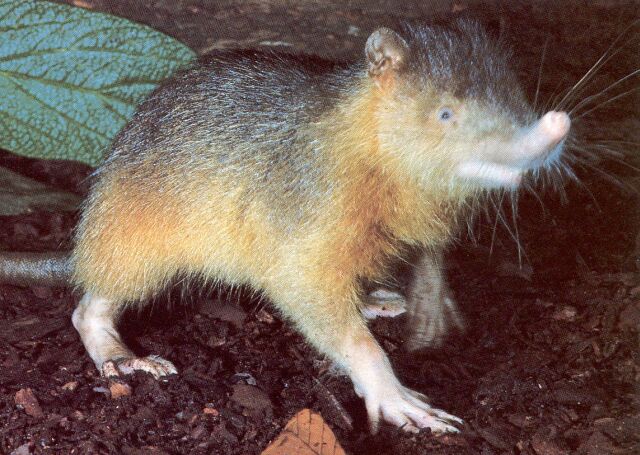
Animal Info - Cuban Solenodon(Other Name: Almiqui)Solenodon cubanus (Atopogale cubana)Status: EndangeredContents1. Profile (Picture) ProfilePicture: Related Species - Haitian Solenodon (Solenodon paradoxus) (76 Kb JPEG) The Cuban solenodon is an insectivore weighing
about 1 kg (2.2 lb). It is found in dense, humid forests and brush country, as well as
around plantations. Insects and spiders found in soil and leaf litter form most of its
diet. The Cuban solenodon is mainly nocturnal,
hiding during the day in rock clefts, hollow trees, or burrows which it excavates itself.
Solenodons obtain food by rooting in the ground with their snouts and by tearing into
rotten logs and trees with their foreclaws. The 1 or 2 young in a litter are born in a
nesting burrow. Tidbits*** By 1970, some presumed the Cuban solenodon to be extinct, since no specimens had been collected since 1890. *** As in most nocturnal terrestrial insectivores, its sense of touch is highly developed, while smell and hearing are also important. *** Solenodons can climb near-vertical surfaces, but they spend most of the time foraging on the ground. *** The Cuban and Haitian solenodons secrete poison from a gland above their teeth to subdue prey. *** Solenodons have a long life span and low reproductive rate, as a result of having been among the dominant predators before Europeans colonized the New World. Status and TrendsIUCN Status:
Countries Where the Cuban Solenodon Is Currently Found:2004: Occurs in Cuba. (IUCN 2004) Population Estimates:
History of Distribution:By 1970, some thought that the Cuban solenodon had become extinct, since no specimens had been found since 1890. However, three were captured in 1974 and 1975, and subsequent surveys showed that it still occurred in many places in central and western Oriente Province, at the eastern end of Cuba. However, it is rare everywhere. Distribution Map (11 Kb) (InfoNatura) Threats and Reasons for Decline:Introduction of the Burmese mongoose into Cuba is believed to have accounted for the near-extermination of the solenodon. Currently, feral cats are probably the greatest threat, since the areas the solenodon inhabits now is not good mongoose habitat. In addition to predation by introduced predators, habitat loss is also a factor contributing to the solenodon's rarity. The Cuban solenodon is not hunted for food. Data on Biology and EcologyWeight:
Habitat:
Birth Rate:
Early Development:
Dispersal:
Diet:
Behavior:
Social Organization:
ReferencesBurton & Pearson 1987, Cons. Intl., Curry-Lindahl 1972, InfoNatura, IUCN 1969, IUCN 1994, IUCN 1996, IUCN 2000, IUCN 2003a, IUCN 2004, Macdonald 1984, Nowak & Paradiso 1983, Olson & Dinerstein 1998, Olson & Dinerstein 1999, Oryx 1972, Oryx 1977b, Phillip & Fisher 1970, Varona 1980 Top of Page | Search This Site Home | Rarest Mammals | Species Index | Species Groups Index | Country Index | Links Last modified: November 2, 2005; |
|
© 1999 - 2019
Animal
Info. Endangered animals of the
world.
Contact Us.. |