|
|
|
|
|
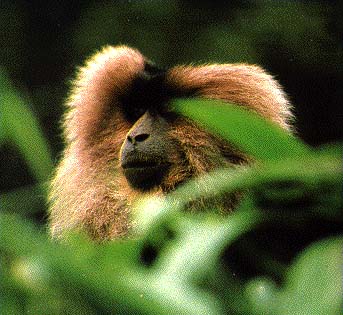
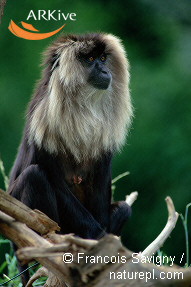
Animal Info - Lion-tailed Macaque(Other Names: Arakkan, Chingala, Karangu, Karingode, Kondamachu, Kuram, Macaca Leonina, Macaco Barbudo, Macaque à Queue de Lion, Macaque Ouandérou, Neel Bandar, Nella Manthi, Ouandérou, Siah Bandar, Singalika, Wanderoo)Macaca silenusStatus: EndangeredContents1. Profile (Picture) ProfilePictures: Lion-tailed Macaque #1 (32 Kb JPEG); Lion-tailed Macaque #2 (22 Kb JPEG) (Arkive) The lion-tailed macaque weighs 7 - 15 kg (15 - 33 lb). It is found in tropical
evergreen forest, where it is omnivorous and diurnal and primarily arboreal. Groups of lion-tailed macaques range from 4
- 34 individuals. They usually contain about 10 - 20 individuals, including 1 - 3 adult
males. Tidbits*** The lion-tailed macaque seems to be unable to adapt to human settlement; for example, it apparently doesn't travel through plantations or use them as habitat. Status and TrendsIUCN Status:
Countries Where the Lion-tailed Macaque Is Currently Found:2004: Occurs in India (Karnataka, Kerala, Tamil Nadu) (IUCN 2004). Population Estimates:
History of Distribution:The lion-tailed macaque has never been common. By 1971 it was known to occur only in the southern third of India, generally in the Western Ghats. In 1984 it was thought to occur in scattered locations in Karnataka, Kerala and Tamil Nadu, from the northern Kanara district of Karnataka in the north to the Ashambu Hills near the tip of the Indian subcontinent in the south (Groombridge 1984). The population is severely fragmented (IUCN 2002). Threats and Reasons for Decline:The major reason for its decline appears to have been habitat loss due to the spread of agriculture and teak, coffee, tea and other plantations. Formerly it was extensively captured for the pet trade, zoos and research, as well as for use in Oriental medicine. Data on Biology and EcologyWeight:
Habitat:
Age to Maturity:
Gestation Period:
Diet:
Behavior:
Social Organization:
Density and Range:
Minimum Viable Population:
ReferencesArkive, AZA 1998, Burton & Pearson 1987, Choudhury 1988, Cons. Intl. 2005, Curry-Lindahl 1972, Groombridge 1984, Hill 1971, IUCN 1994, IUCN 1996, IUCN 2000, IUCN 2003a, IUCN 2004, Macdonald 1984, Nowak & Paradiso 1983, Olson & Dinerstein 1998, Olson & Dinerstein 1999, Oryx 1979c, Oryx 1981b, Silva & Downing 1994 Top of Page | Search This Site Home | Rarest Mammals | Species Index | Species Groups Index | Country Index | Links Last modified: June 4, 2005; |
|
© 1999 - 2019
Animal
Info. Endangered animals of the
world.
Contact Us.. |