|
|
|
|
|
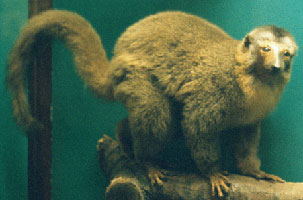
Animal Info - Mongoose Lemur(Other Names: Dredrika, Gidro, Komba, Lemur Mangosta, Lémur Mongoz, Maki Mongoz, Mongozmaki)Eulemur mongoz (Lemur m., Lemur mongoz m.)Status: VulnerableContents1. Profile (Picture) ProfilePictures: Mongoose Lemur #1 (18 Kb JPEG); Mongoose Lemur #2 (21 Kb JPEG) The mongoose lemur is a medium-sized lemur, about the size of a small house cat. Its head and body length is about 35 cm (14"), and it weighs about 2 kg (4.4 lb). It maintains a horizontal body posture and moves quadrupedally. In Madagascar the mongoose lemur is found in dry deciduous forest and secondary forest. In Comoros it is found in humid forest. It is arboreal. During both the wet and the dry seasons, fruit appears to dominate the mongoose lemur diet. In the wet season, it is also known to feed on fresh flowers, particularly those from the kapok tree. In addition, the mongoose lemur is extremely fond of nectar. More so than other lemurs, the mongoose lemur is active at different times of the day, depending on the season. During the wet months (December to April) there is considerably more diurnal and/or crepuscular (evening) activity. With the onset of the dry season in May, there is a shift towards nocturnal behavior. Mongoose lemurs live in small family groups consisting of a monogamous adult pair and 1 - 4 of their immature offspring. Social bonds within these family units appear to be strong, with groups being very cohesive during feeding, traveling, resting and sleeping. Home ranges are small and there is often overlap with the range of another group. Neighboring groups encounter each other rarely, but when they do, the encounters are marked by aggressive vocalizations, much scent marking and physical charges and threats. The mongoose lemur has always been uncommon. Its natural range is restricted to northwest Madagascar. It has also been introduced to Comoros, where populations occur on the islands of Anjouan and Moheli. Major reasons for the decline of the mongoose lemur include the destruction of its forest habitat due to logging and agriculture, hunting for food, and persecution due to its alleged raids on crops. The dry deciduous forests of northwestern Madagascar continue to be cleared to create pastureland and produce charcoal. This loss of habitat is the primary threat to the survival of the mongoose lemur, but it is also hunted for food throughout much of its range. In addition, it is occasionally trapped for the pet trade. In Comoros, the mongoose lemur faces similar threats. Tidbits*** It has been illegal to kill mongoose lemurs in Comoros since 1974, but few Comoriens are aware of this (Reason & Trewhella 1994). Status and TrendsIUCN Status
Countries Where the Mongoose Lemur Is Currently Found:2004: Occurs in Madagascar and Comoros: Mwali (Moheli) & Nzwani (Anjouan). (IUCN 2004) Population Estimates:
History of Distribution:The mongoose lemur has always been uncommon. Its natural range is restricted to northwest Madagascar, from the region west of the Mahavavy River (in the vicinity of Mitsinjo) to somewhere north of Boriziny, but south of Antsohihy. It has also been introduced to Comoros, where populations occur on the islands of Anjouan and Moheli. (Mittermeier et al. 1994, Garbutt 1999) Threats and Reasons for Decline:Major reasons for the decline of the mongoose lemur include the destruction of its forest habitat due to logging and agriculture, hunting for food, and persecution due to its alleged raids on crops. The dry deciduous forests of northwestern Madagascar continue to be cleared to create pastureland and produce charcoal. This loss of habitat is the primary threat to the survival of the mongoose lemur, but it is also hunted for food throughout much of its range. In addition, it is occasionally trapped for the pet trade. In Comoros, the mongoose lemur faces similar threats. (Garbutt 1999, Duke Univ. Prim. Ctr. 2004) Data on Biology and EcologySize and Weight:
Habitat:
Age to Maturity:
Gestation Period:
Birth Season:
Birth Rate:
Early Development:
Diet:
Behavior:
Social Organization:
Density and Range:
Minimum Viable Population:
ReferencesBurton & Pearson 1987, Cons. Intl. 2005, Curtis & Zarmody 1998, Duke Univ. Prim. Ctr. 2004, Garbutt 1999, IUCN 1969, IUCN 1994, IUCN 1996, IUCN 2000, IUCN 2003a, IUCN 2004, Macdonald 1984, Macdonald 2001, Madagascar Fauna Group, Mittermeier et al. 1994, Nowak & Paradiso 1983, Olson & Dinerstein 1998, Olson & Dinerstein 1999, Primate Info Net, Reason & Trewhella 1994, Rowe 1996, Silva & Downing 1994 Top of Page | Search This Site Home | Rarest Mammals | Species Index | Species Groups Index | Country Index | Links Last modified: June 1, 2005; |
|
© 1999 - 2019
Animal
Info. Endangered animals of the
world.
Contact Us.. |