|
|
|
|
|
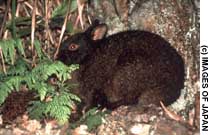
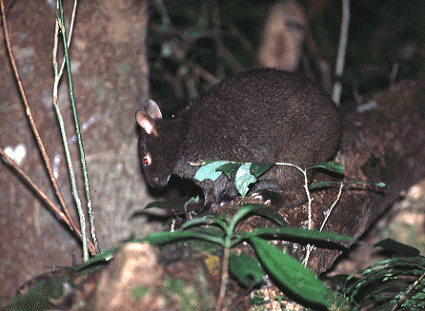
Animal Info - Amami Rabbit(Other Names: Amami Hare, Ryukyu Rabbit)Pentalagus furnessiStatus: EndangeredContents1. Profile (Picture) ProfilePictures: Amami Rabbit #1 (13 Kb JPEG); Amami Rabbit #2 (92 Kb GIF) The Amami rabbit weighs 2 - 3 kg (4.4 - 6.6 lb). It is found in dense forests of all
successional stages, especially old growth forest. It has also been observed in cut-over
areas and forest edges covered by Japanese pampas grass. It has not been observed in
cultivated or residential areas. Its food includes bamboo
shoots, berries and the leaves and stems of sweet potatoes. The Amami rabbit is generally nocturnal. Burrows are used for dens and nests. Two
litters of 2-3 young are born each year. Until 1921, its major threat was hunting for meat and oriental medicine. Since then, predation by stray dogs (and possibly feral cats) and the introduced mongoose and, especially in the last several decades, habitat loss due to logging operations have been the most significant threats. Tidbits*** The existence of the Amami rabbit is not widely known among the people of Japan. *** Rabbits (belonging to many different genera) vs. Hares (all in the genus Lepus): The major differences between rabbits and hares include: 1.) their methods in avoiding predators (rabbits hide in dense vegetation or burrows; hares have longer legs and try to outrun predators), and 2.) the characteristics of their young at birth (newborn rabbits ("kittens") are born naked and with their eyes closed; newborn hares ("leverets") are better developed - their eyes are open and they can move around with some degree of coordination) (Macdonald 2001). Status and TrendsIUCN Status:
Countries Where the Amami Rabbit Is Currently Found:2004: Occurs in Japan (Amami Oshima and Tokunoshima Islands) (IUCN 2004). Population Estimates:
History of Distribution:The Amami rabbit is only known to have occurred on two Japanese islands: Amami Oshima (710 sq km/273 sq mi) and Tokunoshima (250 sq km/96 sq mi), in the Ryukyu Archipelago south of the island of Kyushu. By 1900 its numbers were considerably reduced by over-hunting. In 2002 it was still reported to occur on both islands (IUCN 2004). Threats and Reasons for Decline:Until 1921, its major threat was hunting for meat and oriental medicine. Since then, predation by stray dogs (and possibly feral cats) and the introduced mongoose and, especially in the last several decades, habitat loss due to logging operations have been the most significant threats. Data on Biology and EcologyWeight:
Habitat:
Birth Season:
Birth Rate:
Diet:
Behavior:
ReferencesBurton & Pearson 1987, Chapman & Flux 1990, Curry-Lindahl 1972, IUCN 1966, IUCN 1994, IUCN 1996, IUCN 2000, IUCN 2003a, IUCN 2004, Macdonald 1984, Macdonald 2001, Nowak & Paradiso 1983, Olson & Dinerstein 1998, Olson & Dinerstein 1999, Oryx 1980b, Smith 1998, WCMC/WWF 1997 Top of Page | Search This Site Home | Rarest Mammals | Species Index | Species Groups Index | Country Index | Links Last modified: March 11, 2006; |
|
© 1999 - 2019
Animal
Info. Endangered animals of the
world.
Contact Us.. |