|
|
|
|
|
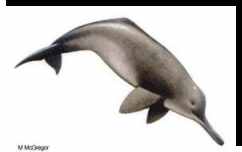
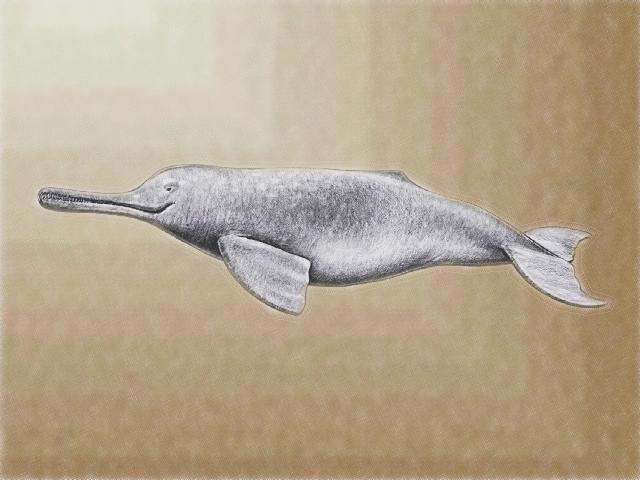
Animal Info - Indus River Dolphin(Other Names: Bhulan, Blind River Dolphin, Delfín del Indo, Indus Dolphin, Indus Susu, Plataniste de l'Indus, Side Swimming Dolphin, Susu)Platanista gangetica minor (P. indi, P. minor)Status: EndangeredContents1. Profile (Picture) ProfilePictures: Indus River Dolphin #1 (3 Kb JPEG) (Cetacea); Indus River Dolphin #2 (31 Kb JPEG) (Swiss Cet. Soc.) The Indus River Dolphin has a long beak and a stocky body. It has a low triangular hump on its back in place of a 'true' dorsal fin. It is gray-brown in color, sometimes with a pinkish belly. The eyes are extremely small, resembling pinhole openings slightly above the mouth. The Indus River dolphin measures between 1.5 - 2.5 m (5 - 8') in length and weighs 80 - 90 kg (180 - 200 lb). The Indus River dolphin generally occurs in the deepest river channel and is less common in secondary channels and small braids. Reported habitat preferences include channel constrictions, confluences, and deep, low-velocity water. The Indus River dolphin feeds mostly on several species of fish and invertebrates. It does much of its feeding at or near the bottom, using echolocation, swimming on one side, and probing the river bottom with its snout and its flipper. Although it is not usually considered to be gregarious, relatively high densities are found at sites where rivers join, in areas where the current is relatively weak, off the mouths of irrigation canals, and near villages and ferry routes. The Indus River dolphin is endemic to the rivers of the lower Indus River basin in Pakistan. Historically, it ranged from the Indus delta upstream to the Himalayan foothills where rocky barriers or shallow water prevented further upstream movement. Currently the distribution of the Indus River dolphin is severely fragmented and dramatically reduced in extent. The linear extent of its occurrence has declined from approximately 3,400 km (2100 mi) of Indus River mainstem and its tributaries in the 1870's to approximately 1,000 km (600 mi) of the mainstem at present. Currently the Indus River dolphin is limited to three subpopulations in the Indus mainstem located between the Chashma and Taunsa, Taunsa and Guddu, and Guddu and Sukkur Barrages. (IUCN 2006) The main reason for the decline of the Indus River dolphin was the construction of numerous dams and barrages, starting in the 1930's, that have fragmented the population and reduced the amount of available habitat. Another severe threat to the survival of the Indus River Dolphin is probably the increasing withdrawal of water. Dolphins no longer occur in the lower reaches of the Indus because upstream water extraction leaves downstream channels virtually dry for several months each year. Tidbits*** The Indus River dolphin is one of the world's rarest mammals. *** Although its eye lacks a lens, and it is sometimes referred to as being blind, the Indus River dolphin's eye does seem to function as a direction-finding device by using the direction and intensity of light. *** In Pakistan, conservation is a provincial responsibility. The government of Sind has given the Indus River dolphin full legal protection and established the Indus River Dolphin Reserve. The legal protection was widely publicized in an intensive campaign at all levels of government and society, and seems to be observed. The dolphin population in the Reserve appears to be increasing. (Klinowska 1991) Status and TrendsIUCN Status:
Countries Where the Indus River Dolphin Is Currently Found:2006: Occurs in the Indus River system in Pakistan (IUCN 2006). Taxonomy:The Indus and Ganges River dolphin populations, previously treated as separate species, have recently been reduced to subspecies of a single species. The new species is named the "Ganges River dolphin" (Platanista gangetica), with two subspecies - the Ganges River dolphin (Platanista gangetica gangetica) and the Indus River dolphin (P. g. minor). Under this new assignment of scientific names, the newly named species as well as the two subspecies retain the listing of "Endangered" by the IUCN. (IUCN 2003a, Reeves 2004) Population Estimates:
History of Distribution:The Indus River dolphin is endemic to the rivers of the lower Indus River basin in Pakistan. Historically it occurred in the Indus River mainstem and the Sutlej, Beas, Ravi, Chenab, and Jhelum tributaries. It ranged from the Indus delta upstream to the Himalayan foothills where rocky barriers or shallow water prevented further upstream movement. Currently the distribution of the Indus River dolphin is severely fragmented and dramatically reduced in extent. The linear extent of its occurrence has declined from approximately 3,400 km (2100 mi) of Indus River mainstem and its tributaries in the 1870's to approximately 1,000 km (600 mi) of the mainstem at present. An estimated 99% of the Indus River dolphin population occurs in only 690 linear km (430 mi). Currently the Indus River dolphin is limited to three subpopulations in the Indus mainstem located between the Chashma and Taunsa, Taunsa and Guddu, and Guddu and Sukkur Barrages. (IUCN 2006) Distribution
Map #1S (22 Kb JPEG) (WCMC/CMS)
(smaller map) Threats and Reasons for Decline:The main reason for the decline of the Indus River dolphin was the construction of numerous dams and barrages, starting in the 1930's, that have fragmented the population and reduced the amount of available habitat. Another severe threat to the survival of the Indus River Dolphin is probably the increasing withdrawal of water. Dolphins no longer occur in the lower reaches of the Indus because upstream water extraction leaves downstream channels virtually dry for several months each year. Accidental capture in fishing nets; pollution; and hunting for meat, oil and traditional medicine have also had an impact. (IUCN 2006) Data on Biology and EcologySize and Weight:
Habitat:
Age to Maturity:
Gestation Period:
Birth Season:
Birth Rate:
Early Development:
Maximum Age:
Diet:
Behavior:
Social Organization:
Age and Gender Distribution:
Density:
ReferencesBonner 1989, Burton & Pearson 1987, Cetacea, Culik 2003c, IUCN 1994, IUCN 1996, IUCN 2000, IUCN 2002, IUCN 2003a, IUCN 2006, IWC 2000, Klinowska 1991, Macdonald 1984, Nowak & Paradiso 1983, Nowak 1999, Olson & Dinerstein 1998, Olson & Dinerstein 1999, Reeves & Chaudhry 1998, Reeves et al. 2000, Reeves et al. 2003, Reeves 2004, Swiss Cet. Soc. Top of Page | Search This Site Home | Rarest Mammals | Species Index | Species Groups Index | Country Index | Links Last modified: June 11, 2006; |
|
© 1999 - 2019
Animal
Info. Endangered animals of the
world.
Contact Us.. |