|
Translate:
       
Animal Info - Otter Civet
(Other Names: 獭灵猫,
キノガーレ, Cibeta Nutria, Civette-Loutre de Sumatra,
Lontra almiscareira de Sumatra, Otterzivette, Water Civet)
Cynogale bennettii
Contents
1. Profile (Picture)
2. Tidbits
3. Status and Trends (IUCN Status, Countries Where Currently Found, History of
Distribution, Threats and Reasons for Decline)
4. Data on Biology and Ecology (Weight, Habitat, Birth Season, Birth
Rate, Maximum Age, Diet, Behavior)
5. References
Profile
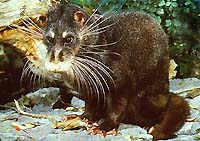
Picture: Otter
Civet (21 Kb JPEG)
The otter civet weighs 3 - 5 kg (6.6 - 11 lb). It is found in and near streams, rivers
and wetlands, eating fish, frogs, crustaceans,
freshwater molluscs, and to a lesser extent, small mammals, birds and fruit.
The otter civet is found in Peninsular Malaysia,
southern Thailand, Sumatra and Borneo, and
possibly Vietnam. Although widespread it is rare
throughout most of its range. It is threatened by the loss of wetlands and other aquatic
habitat to development, siltation from mines, persistent pesticides in the food chain, and
other kinds of water pollution.
Tidbits
*** Little is known about either the ecology or conservation status of this amphibious
civet (Heydon & Ghaffar 1997)
*** Although it is partly adapted for an aquatic life, its tail is short and lacks
special muscular power, and the webbing between the toes is only slightly developed.
Therefore it is probably a slow swimmer and cannot turn quickly in the water (Nowak & Paradiso 1983).
*** It can close its ears to exclude water and its nostrils open upward. It is said to
lie in ambush in the water with only its eyes and nostrils exposed, much like a crocodile (Humphrey & Bain 1990)
*** It is apparent that this civet, like other civets, persists after selective logging
(Heydon & Ghaffar 1997).
Status and Trends
Countries Where the Otter Civet Is Currently Found:
2004: Occurs in Brunei, Indonesia, Malaysia,
Thailand, Vietnam.
May occur in Singapore (IUCN
2004).
History of Distribution:
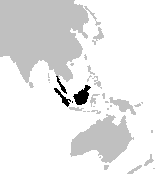
At least since the 1960's, the otter civet's range has been thought to include
Peninsular Malaysia, southern Thailand, Sumatra and Borneo, and possibly Vietnam. Although widespread it has been rare
throughout most of its range during this period.
Distribution Map (2 Kb GIF)
Threats and Reasons for Decline:
Threats to the otter civet include the loss of wetlands and other aquatic habitat to
development, siltation from mines, persistent pesticides in the food chain, and other
kinds of water pollution.
Data on Biology and Ecology
The otter civet weighs 3 - 5 kg (6.6 - 11 lb).
Habitat:
The otter civet is found in and near streams, rivers and wetlands.
The otter civet lives in both the Sundaland
Biodiversity
Hotspot (Cons.
Intl. 2005) as well as the Mt.
Kinabalu Montane & Alpine Scrub & Forest and the Peninsular Malaysian Lowland
& Montane Forests Global 200 Ecoregions (Olson & Dinerstein 1998, Olson & Dinerstein 1999).
Birth Season:
Young, still with the mother, have been noted in May in Borneo.
Birth Rate:
There are records of pregnant females with 2 and 3 embryos.
Maximum Age:
At least 5 years in captivity.
Diet:
The otter civet eats fish, frogs, crustaceans,
freshwater molluscs, and to a lesser extent, small mammals, birds and fruit.
Behavior:
The otter civet can climb well and does so when chased by dogs.
References
Burton & Pearson 1987, Cons.
Intl. 2005, Heydon & Ghaffar 1997, Humphrey & Bain 1990, IUCN 1968, IUCN 1994,
IUCN 1996, IUCN 2000,
IUCN 2003a, IUCN
2004, Nowak & Paradiso 1983, Olson & Dinerstein 1998, Olson & Dinerstein 1999, Russian
Web Site
Top of Page | Search
This Site
Home | Rarest
Mammals | Species Index | Species Groups Index | Country
Index | Links
Last modified: March 3, 2006;
|