Animal Info - Fea's Muntjac
(Other Names: Barking Deer, Fea's Munjac)
Muntiacus feae
Status: Data
Deficient
Contents
1. Profile (Picture)
2. Tidbits
3. Status and Trends (IUCN Status, Countries Where
Currently Found, Population Estimates, History of Distribution, Threats and Reasons
for Decline)
4. Data on Biology and Ecology (Weight, Habitat, Gestation Period, Diet,
Behavior, Social Organization)
5. References
Profile
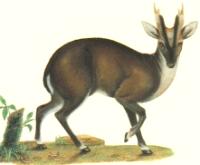
Picture: Fea's
Muntjac (6 Kb JPEG)
Fea's muntjac weighs 18 - 21 kg (40 - 46 lb). It is usually found in evergreen forests
in upland areas. In China it has been found in
mountainous forest comprised of a mixture of coniferous,
broad-leaf forest or shrub forest at an altitude of 2500 m (8200'). Young muntjacs are
usually born in dense growth, where they remain hidden until they can move about with the
mother. Muntjacs eat grasses, low-growing leaves, and tender shoots. Fea's muntjac is diurnal and solitary.
In 1984, Fea's muntjac was documented in Yunnan Province in southcentral China. It is also thought to occur in the Tenasserim
area in the southern tip of Myanmar and adjacent
regions in Thailand, as well as in Laos and Vietnam.
Fea's muntjac was apparently never very abundant. It is now quite rare. Its total numbers
are unknown but are certainly small.
Reasons for the decline of Fea's muntjac include hunting (including armed insurgents
living off the land) and the increase of human settlement.
Tidbits
*** Fea's muntjac has been considered a nuisance in some areas because it destroys
trees by ripping off the bark.
*** Muntjacs are also known as "barking deer" because they make a deep,
barklike sound as a warning if they sense a predator nearby.
Status and Trends
- 1960's: Insufficiently Known
- 1970's - 1994: Endangered
- 1996 - 2004: Data Deficient (IUCN
2004)
Countries Where Fea's Muntjac Is Currently Found:
2004: Occurs in China, Laos, Myanmar, Thailand (introduced) and Vietnam.
(IUCN 2004)
Population Estimates:
[Note: Figures given are for wild populations only.]
History of Distribution:
In 1984 Fea's muntjac was documented in Yunnan Province in southcentral China. It is also thought to occur in the Tenasserim
area in the southern tip of Myanmar and adjacent
regions in Thailand, as well as in Laos and Vietnam.
Fea's muntjac was apparently never very abundant. It is now quite rare. Its total numbers
are unknown but are certainly small.
Threats and Reasons for Decline:
Reasons for the decline of Fea's muntjac include hunting (including armed insurgents
living off the land) and the increase of human settlement.
Data on Biology and Ecology
Fea's muntjac weighs 18 - 21 kg (40 - 46 lb).
Habitat:
Fea's muntjac is usually found in evergreen forests in upland areas. In China it has been found in mountainous forest comprised
of a mixture of coniferous, broad-leaf
forest or shrub forest at an altitude of 2500 m (8200').
Fea's muntjac lives in both the Indo-Burma
Biodiversity
Hotspot (Cons.
Intl. 2005) as well as the Kayah-Karan/Tenasserim Moist Forests Global 200
Ecoregion (Olson & Dinerstein
1998, Olson & Dinerstein 1999).
180 days.
Diet:
Muntjacs eat grasses, low-growing leaves, and tender shoots.
Behavior:
Young muntjacs are usually born in dense growth, where they remain hidden until they
can move about with the mother. Fea's muntjac is diurnal.
Social Organization:
Fea's muntjac is solitary.
References
Burton & Pearson 1987, Cons.
Intl. 2005, Curry-Lindahl 1972, Hogee
1984, Humphrey & Bain 1990, IUCN 1968, IUCN 1994,
IUCN 1996, IUCN 2000,
IUCN 2003a, IUCN
2004, Macdonald 1984, Nowak 1999, Nowak
& Paradiso 1983, Olson &
Dinerstein 1998, Olson & Dinerstein
1999, Schaller & Vrba 1996
Top of Page | Search
This Site
Home | Rarest
Mammals | Species Index | Species Groups Index | Country
Index | Links
Last modified: March 5, 2005;
|