|
|

|
|
|
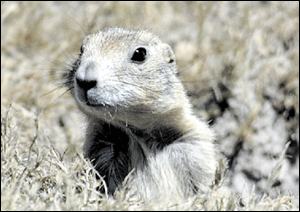
Animal Info - Mexican Prairie Dog(Other Names: Chien de Prairie du Mexique, Mexican Prairie Marmot, Perrito de las Praderas, Perrito Llanero Mejicano)Cynomys mexicanusStatus: EndangeredContents1. Profile (Picture) ProfilePictures: Mexican Prairie Dog #1 (6 Kb JPEG); Mexican Prairie Dog #2 (15 Kb JPEG) (Squir. Arnd. World.) The Mexican prairie dog weighs about 1 kg (2.2 lb). It occupies deep rock-free soils in
open plains and plateaus of inter-montane valleys. These flat areas are covered with herbs
and grasses and usually surrounded by mature desert vegetation. It occurs within an
altitude range of 1600 - 2200 m (5250 - 7200'). The Mexican prairie dog eats herbs and
grasses. It is diurnal and terrestrial and lives in "towns"
(colonies) where it excavates elaborate burrows for shelter and protection from predators.
These towns may contain hundreds of animals, depending on habitat availability, but
currently many towns only include 50 or less animals. There is generally a single dominant
male in the town. Tidbits*** The Mexican prairie dog is the southernmost species of prairie dog. *** Spotted ground squirrels (Spermophilus spilosoma) and burrowing owls (Speotyto cunicularia) often share the prairie dog burrows (WCMC/WWF 1997ab) Status and TrendsIUCN Status:Countries Where the Mexican Prairie Dog Is Currently Found:2004: Occurs in Mexico (IUCN 2004). History of Distribution:In 1956, the Mexican prairie dog was reported to occur in southeastern Coahuila, adjacent parts of Nuevo Leon, San Luis Potosi and probably in Zacatecas, Mexico (IUCN 1968). By the 1980's, it was apparently confined to an area of less than 800 sq km (310 sq mi) in southern Coahuila and northern San Luis Potosi in northern Mexico (Burton & Pearson 1987). Distribution Map (16 Kb) (InfoNatura) Threats and Reasons for Decline:Habitat loss due to agriculture and cattle raising activities is the main reason for the Mexican prairie dog's decline. It has also been hunted by man for food and sporadically poisoned by local residents, since the prairie dog is considered to be an agricultural pest. Data on Biology and EcologyWeight:
Habitat:
Birth Season:
Birth Rate:
Diet:
Behavior:
Social Organization:
ReferencesBurton & Pearson 1987, InfoNatura, IUCN 1968, IUCN 1994, IUCN 1996, IUCN 2000, IUCN 2003a, IUCN 2004, Nowak & Paradiso 1983, Squir. Arnd. World., WCMC/WWF 1997ab Top of Page | Search This Site Home | Rarest Mammals | Species Index | Species Groups Index | Country Index | Links Last modified: February 12, 2005; |
|
© 1999 - 2019
Animal
Info. Endangered animals of the
world.
Contact Us.. |