|
|

|
|
|
Animal Info - Golden-rumped Lion Tamarin(Other Names: Black Lion Tamarin, Mico Leão Preto, Sagui, Sauim Preto)Leontopithecus chrysopygus (L. rosalia c., Leontideus c.)Status: Critically EndangeredContents1. Profile (Picture) ProfilePictures: Golden-rumped Lion Tamarin #1 (10 Kb JPEG) (The Last Noah's Ark); Golden-rumped Lion Tamarin #2 (7 Kb JPEG) (Kids Ecology Corps) Lion tamarins have a mane derived from long hairs on the top of the head, cheeks and throat. The head and body length of the golden-rumped lion tamarin averages about 30 cm (12" ), and it weighs approximately 0.6 kg (1.3 lb). It is mostly black with varying amounts of reddish-golden coloration on the rump, thighs and at the base of its tail.
The golden-rumped lion tamarin occurs in primary lowland tropical forests up to
700 m (2300') in elevation, including semi-deciduous inland forests, humid coastal plain forests
and littoral vegetation types. It prefers dense areas of vegetation,
especially where bromeliads occur.
Fruit, insects, nectar, and exudates
comprise its diet.
The golden-rumped lion tamarin is diurnal and predominantly arboreal. It spends most of its time in the middle levels
of the forest at 7 - 15 m (23 - 50') above the ground, although it comes to the ground to
forage for prey in leaf litter. Groups of golden-rumped lion tamarins include 2 - 11
members (average: 3.6 members). Groups have home
ranges of 66 - 200 hectares (165 - 500 acres). More than 90% of the original Atlantic coastal forest, which contains the golden-rumped lion tamarin's habitat, has been lost or fragmented to obtain lumber and charcoal and to clear out areas for plantations, cattle pasture, and industry. Fire and hunting also are threats. Even in reserves where the golden-rumped lion tamarin occurs, there are problems with squatters degrading and cutting down the few habitat patches that remain, and the fragmentation of its habitat is extreme. Tidbits*** The golden-rumped lion tamarin is one of the world's rarest mammals. *** The Jesuit Antonio Pigafetta, who documented Magellan's voyage around the world, referred to lion tamarins as "beautiful, simian-like cats similar to small lions." (Macdonald 2001) *** Conservation of the golden-rumped lion tamarin may depend on providing for the exchange of individual tamarins between the widely scattered populations to promote genetic diversity. This would require convincing landowners to allow forested corridors to grow between the populations or translocating the animals as part of a management plan. *** As part of an environmental education, landowners have agreed to preserve 5000 hectares (12,500 acres) of privately owned forest habitat of golden-rumped lion tamarins. Status and TrendsIUCN Status:
Countries Where the Golden-rumped Lion Tamarin Is Currently Found:2004: Occurs in Brazil (IUCN 2004). Taxonomy:In the past, the golden-rumped lion tamarin and the golden-headed lion tamarin (Leontopithecus chrysopygus) were both considered subspecies of the golden lion tamarin (Leontopithecus rosalia). Population Estimates:
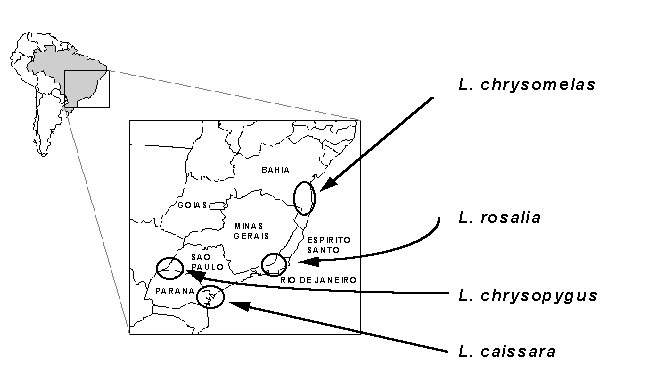
History of Distribution:The golden-rumped lion tamarin has only been known from the interior of the state of Sao Paulo, Brazil, between the Rio Paranapanema and the Rio Tiete, where it once occupied a large forested area. Much of its habitat had been cleared by the early 1900's and it was not seen between 1905 and 1970. In 1970 a small population was discovered in the Morro do Diabo State Park in southwest Sao Paulo. As of 1981 it was only known from the Morro do Diabo State Park and a second remnant population near Galia, Sao Paulo. By 2003 a total of 11 highly fragmented populations were known, with the large majority in the Morro do Diabo State Park (IUCN 2004, Medici et al. 2003). Distribution Map #1 (7 Kb GIF) Threats and Reasons for Decline:More than 90% of the original Atlantic coastal forest, which contains the golden-rumped lion tamarin's habitat, has been lost or fragmented to obtain lumber and charcoal and to clear out areas for plantations, cattle pasture, and industry. Fire and hunting also are threats. Even in reserves where the golden-rumped lion tamarin occurs, there are problems with squatters degrading and cutting down the few habitat patches that remain, and the fragmentation of its habitat is extreme. (Rylands et al. 1996/7, Macdonald 2001). Data on Biology and EcologySize and Weight:
Habitat:
Age to Maturity:
Gestation Period:
Birth Season:
Birth Rate:
Diet:
Behavior:
Social Organization:
Density and Range:
Minimum Viable Population:
ReferencesArkive, Ballou & van Roode 2002, Burton & Pearson 1987, Cons. Intl., Curry-Lindahl 1972, Emmons & Feer 1997, IBAMA 2004, Inst. Ciên. Biol., IUCN 1968, IUCN 1994, IUCN 1996, IUCN 2000, IUCN 2003a, IUCN 2004, Kids Ecology Corps, Kleiman 1981, Kleiman & Mallinson 1998, The Last Noah's Ark, Macdonald 1984, Macdonald 2001, Mamede-Costa & Gobbi 1998, Medici et al. 2003, Natl. Zoo - Cons. Sci., Nowak & Paradiso 1983, Olson & Dinerstein 1998, Olson & Dinerstein 1999, Perry 1971, Rowe 1996, Rylands et al. 1996/7, Seal et al. 1990, Silva & Downing 1994, Stolzenburg 1993 Top of Page | Search This Site Home | Rarest Mammals | Species Index | Species Groups Index | Country Index | Links Last modified: September 10, 2006; |
|
© 1999 - 2019
Animal
Info. Endangered animals of the
world.
Contact Us.. |