|
|

|
|
|
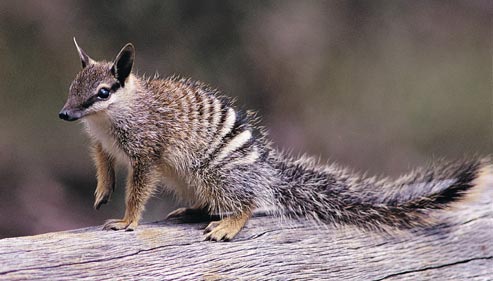
Animal Info - Numbat(Other Names: Banded Anteater, Hormiguero Marsupial, Marsupial Anteater, Walpurti)Myrmecobius fasciatusStatus: VulnerableContents1. Profile (Picture) ProfilePictures: Numbat #1 (32 Kb JPEG) (Austral. Wildl. Cons.); Numbat #2 (33 Kb JPEG) (Milamba Aust.); Numbat #3 (82 Kb JPEG) (Terrambiente) The numbat is a small terrestrial marsupial adapted to feed exclusively on termites. It
is diurnal, being more active in the morning and late
afternoon during the summer and in the middle of the day during the fall. Numbats usually
shelter in fallen hollow logs or dead tree trunks and sometimes in burrows. Currently, the
numbat inhabits woodland with grassy, herbaceous or shrub understory. It lives in family
groups for part of the year; however, adults forage alone. Tidbits*** The numbat eats up to 20,000 termites daily. *** It is the only marsupial that is not at least partly nocturnal. Its diurnal behavior pattern reflects termite behavior patterns. *** In 1974 it was selected as the State Animal of Western Australia. Status and TrendsIUCN StatusCountries Where the Numbat Is Currently Found:2004: Occurs in Australia (southwestern Western Australia) (IUCN 2004). History of Distribution:The numbat was once distributed over 25% of the Australian continent. When Europeans first settled the continent, it was widespread across southern semi-arid and arid Australia, from western New South Wales through South Australia and southern Northern Territory to the southwest of Western Australia. It did not occur on islands. Its numbers have declined severely since the beginning of European settlement. The South Australia population probably was extinct by 1923. Its range had shrunk to the southwest of Western Australia by the 1960's. By the late 1980's, only two colonies were left in the wild, west of Ongerup and south of York. In 1990 it was found in the Dryandra State Forest, the Perup Management Priority Area (east of Manjimup), and had recently been discovered in several suburbs south of Perth, all in the southwestern portion of Western Australia. As of 1996 it occurred in the two remnant populations and one self-sustaining reintroduced population in the southwest of Western Australia. Distribution Map (4 Kb GIF) (Maxwell et al. 1996) Threats and Reasons for Decline:Reasons for the numbat's decline include introduced predators such as foxes and the clearing of land for agriculture, which eliminates dead and fallen trees which can be used for shelter and from which termites can be obtained. Another factor could have involved the cessation of Aboriginal fire regimes, especially in arid grasslands. The smaller, controlled fires started by Aborigines reduced the incidence of larger, more devastating bushfires which could wipe out the numbat's habitat, food source and shelter. Data on Biology and EcologyWeight:
Habitat:
Birth Season:
Birth Rate:
Early Development:
Maximum Age:
Diet:
Social Organization:
Density and Range:
ReferencesAustral. Wildl. Cons., Burbidge & McKenzie 1989, Burton & Pearson 1987, Cons. Intl. 2005, Earth Sanct., Flannery 1990, IUCN 1994, IUCN 1996, IUCN 2000, IUCN 2003a, IUCN 2004, Kennedy 1992, Macdonald 1984, Maxwell et al. 1996, Milamba Aust., Nowak & Paradiso 1983, Olson & Dinerstein 1998, Olson & Dinerstein 1999, Oryx 1974b, Oryx 1986c, Oryx 1989b, Terrambiente Top of Page | Search This Site Home | Rarest Mammals | Species Index | Species Groups Index | Country Index | Links Last modified: June 3, 2006; |
|
© 1999 - 2019
Animal
Info. Endangered animals of the
world.
Contact Us.. |