|
|

|
|
|
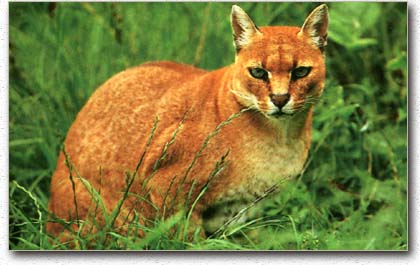
Animal Info - African Golden Cat(Other Names: Afrikanische Goldkatze, A'ka, Akalwa, Chat Doré, Chat Doré Africain, Dondou, Donnou, Ebie, Ebyo, Egabasoti, Ekinyange, Embaka, Esele, Gato Dorado, Gnaou ya Zamba, Golden Cat, Lobwa, Machan Akar, Makolili, Nginya Naracho, Osolimi, Semaguruet, Soukalan)Profelis aurataStatus: VulnerableContents1. Profile (Picture) ProfilePictures: African Golden Cat #1 (27 Kb JPEG) (IUCN Cat Spec. Gr.); African Golden Cat #2 (28 Kb JPEG) (Fauves du Monde); African Golden Cat #3 (31 Kb GIF) (Tigerhomes) The African golden cat is about twice the size of a large domestic cat and robustly built, weighing as much as 16 kg (26 lb). Its fur varies from marmalade orange-red to sepia-gray, and each color phase may be spotted all over, unspotted, or somewhere in between. The throat, chest, and undersides are invariably white or whitish, and the belly is marked with bold dark spots or blotches. Its tail may be distinctly banded, unbanded, or anything in between. The primary habitat of the African golden cat is in the moist forest zone of Equatorial Africa. It is able to live in many types of forest, including primary forest, secondary vegetation, and riverine forest where watercourses penetrate more open habitat. It is known from montane forest, alpine moorland, and bamboo forest at elevations up to 3000 m (10,000'). The African golden cat apparently adapts well to logged areas with a dense understory, probably because destruction of the canopy favors the dense secondary undergrowth with which this cat is often associated. The African golden cat is an opportunistic hunter, taking small mammals (mainly rodents), but also larger prey such as duikers and livestock (sheep and goats). Although it has been suggested that the African golden cat is arboreal, its stocky build and rather short tail, combined with its presence in alpine moorland, would suggest that it is primarily a terrestrial hunter. There are several observations of the African golden cat hunting during the daytime, but based on the activity patterns of its reported prey, it is likely to be primarily crepuscular and nocturnal. The African golden cat is solitary. The primary population is found in central Africa, in the forests of The Democratic Republic of the Congo basin and surrounding areas. It also occurs in West Africa, in the forests of Senegal to Benin, with an apparent gap in Nigeria separating this population from the central African population. Savannization and deforestation in West Africa have probably led to fragmentation and declines in populations of the African golden cat. The bush meat trade is depleting populations of small antelope prey, which may lead to increased livestock depredation by the African golden cat and its consequent persecution. There appears to be little hunting of this cat. Tidbits*** Cat Tidbit #12: A hunting cat holds its whiskers out on either side of its face like a fan. Just before pouncing on its prey, the cat shifts its whiskers forward, extending them like a net in front of its mouth. When the cat makes contact with its prey, the whiskers tell it exactly which way the animal is dodging in the final split second. A cat carrying a freshly caught mouse wraps its whiskers around the prey, sensitive to any twitch that would indicate that the mouthful might squirm free. (Sunquist & Sunquist 2002) (See Cat Tidbit #1.) *** The African golden cat pelt has one distinguishing feature: the fur, from just in front of the shoulders to the crown of the head, changes direction and points forward. The junction of the change in direction of the hair pattern is marked by whorls and a low, crest-like ridge. (Sunquist & Sunquist 2002) Status and TrendsIUCN Status:[The IUCN (International Union for the Conservation of Nature; also called the World Conservation Union) is the world’s largest conservation organization. Its members include countries, government agencies, and non-governmental organizations. The IUCN determines the worldwide status of threatened animals and publishes the status in its Red List.]
Countries Where the African Golden Cat Is Currently Found:2005: Occurs in Angola, Benin, Burundi, Cameroon, Central African Republic, Congo, Côte d'Ivoire, The Democratic Republic of the Congo, Equatorial Guinea, Gabon, Gambia, Ghana, Guinea, Guinea-Bissau, Kenya, Liberia, Rwanda, Senegal, Sierra Leone, Togo and Uganda. May occur in Burkina Faso, Mali, Niger and Nigeria. (IUCN 2005) Taxonomy:Recent genetic analyses have lead to the proposal that all modern cats can be placed into eight lineages which originated between 6.2 - 10.8 million years ago. The African golden cat is placed in the "caracal lineage," which diverged from its ancestors as a separate lineage 8.5 million years ago. The caracal lineage also includes the caracal and the serval. (Johnson et al. 2006) Population Estimates:
Distribution:The primary population is found in central Africa, in the forests of The Democratic Republic of the Congo basin and surrounding areas. It also occurs in West Africa, in the forests of Senegal to Benin, with an apparent gap in Nigeria separating this population from the central African population. There are relict populations of the African golden cat in the moist montane forests of southern Kenya. (IUCN 2005) Distribution Map (2 Kb GIF) (Big Cats Online) Threats and Reasons for Decline:Savannization and deforestation in West Africa have probably led to fragmentation and declines in populations of the African golden cat, unless migration is possible along riverine corridors. The bush meat trade, which is a significant component of the region’s economy, is depleting populations of small antelope prey, which may lead to increased incidence of livestock depredation by the African golden cat and consequent persecution of the cat. There appears to be little hunting of this cat. (IUCN 2005) The fact that the African golden cat does well in secondary forest, combined with its ability to survive on small rodents, suggests that it is in less danger of extinction than many other small cats (Sunquist & Sunquist 2002). Data on Biology and EcologySize and Weight:
Habitat:
Age to Maturity:
Gestation Period:
Birth Season:
Birth Rate:
Maximum Age:
Diet:
Behavior:
Social Organization:
ReferencesBig Cats Online, Boy 2003, Cons. Intl. 2005, Fauves du Monde, IUCN 2005, IUCN Cat Spec. Gr., Johnson et al. 2006, Nowak 1999, Olson & Dinerstein 1998, Olson & Dinerstein 1999, Sunquist & Sunquist 2002, Tigerhomes Top of Page | Search This Site Home | Rarest Mammals | Species Index | Species Groups Index | Country Index | Links Last modified: April 27, 2006; |
|
© 1999 - 2019
Animal
Info. Endangered animals of the
world.
Contact Us.. |