|
|

|
|
|
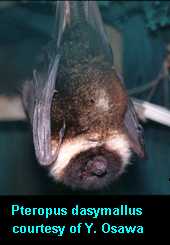
Animal Info - Ryukyu Flying Fox(Other Names: Zorro Volador de Ryukyu)Pteropus dasymallusStatus: EndangeredContents1. Profile (Picture) ProfilePicture: Ryukyu Flying Fox (6 Kb JPEG) The Ryukyu flying fox utilizes forest for daytime roosting. It eats the fruits of a
variety of plant species. Figs are a favorite. It lives in colonies. Tidbits*** Flying foxes are so-called because of their fox-like faces. They cannot use echolocation. Instead, they navigate using vision and normal hearing. *** Most flying foxes eat fruit and are also called fruit bats. Fruit bats are ecologically and economically important because they pollinate and disperse the seeds of wild and commercial plants. *** The Ryukyu flying fox can be a pest of commercial fruit crops. Status and TrendsIUCN Status:
Countries Where the Ryukyu Flying Fox Is Currently Found:2004: Occurs in Japan (Ryukyu Islands: Nansei-shoto). (IUCN 2004) History of Distribution:The Ryukyu flying fox occurs in the Ryukyu Archipelago (Japan). It previously occurred in Taiwan, most recently on the island of Kashoto (= Lutao) (Mickleburgh 1992). It is abundant in the southern and central parts of Okinawa. Populations appear to be large on Ishigaki, Iriomote and Yonayuki. (WCMC/WWF 1997) Threats and Reasons for Decline:Threats apparently include hunting and deforestation on different islands. Data on Biology and EcologyHabitat:
Gestation Period:
Birth Season:
Early Development:
Diet:
Behavior:
Social Organization:
ReferencesBonaccorso 1998, Cons. Intl. 2005, IUCN 1994, IUCN 1996, IUCN 2000, IUCN 2003a, IUCN 2004, Mickleburgh 1992, WCMC/WWF 1997 Top of Page | Search This Site Home | Rarest Mammals | Species Index | Species Groups Index | Country Index | Links Last modified: May 30, 2005; |
|
© 1999 - 2019
Animal
Info. Endangered animals of the
world.
Contact Us.. |