|
Translate:
       
Animal Info - Cuvier's Gazelle
(Other Names:
卡氏羚, Atlas Gazelle, Atlas Mountain Gazelle, Edmi, Edmi Gazelle, Gazelle de Cuvier,
Gazelle de Montagne, Idmi, Ledm, Mountain Gazelle)
Gazella cuvieri (G. gazella cuvieri)
Contents
1. Profile (Picture)
2. Tidbits
3. Status and Trends (IUCN Status, Countries Where
Currently Found, Population Estimates, History of Distribution, Threats and Reasons
for Decline)
4. Data on Biology and Ecology (Weight, Habitat, Gestation
Period, Birth Season, Birth Rate, Maximum Age, Diet, Behavior, Social Organization)
5. References
Profile
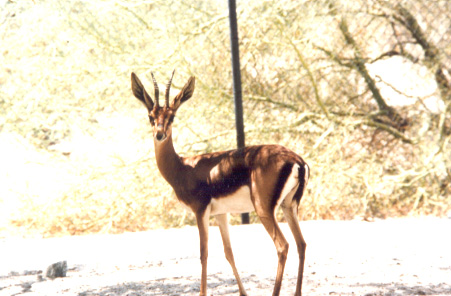
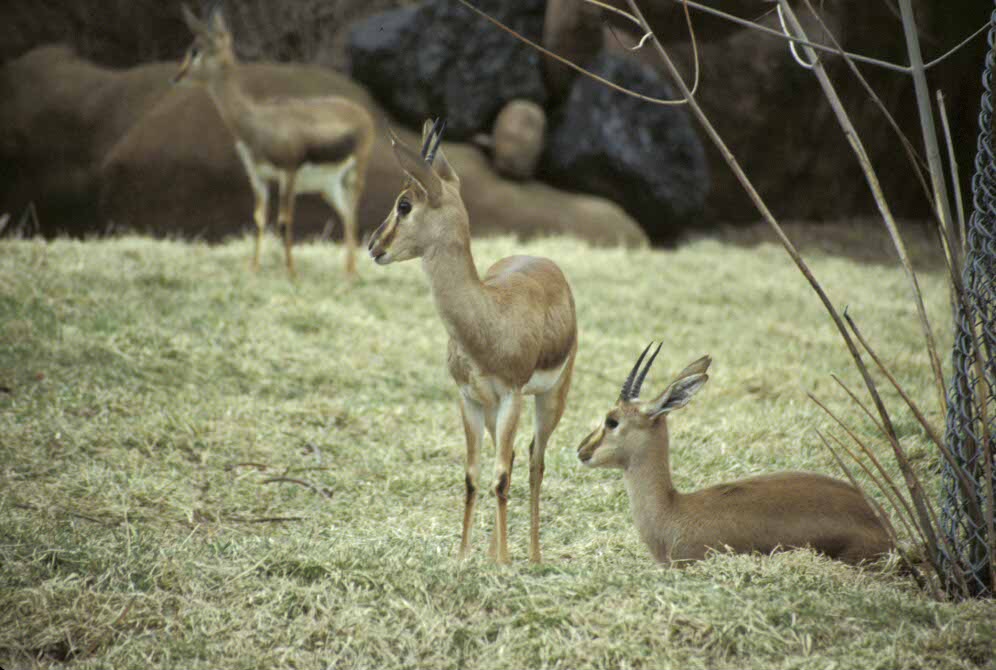
Pictures: Cuvier's
Gazelle #1 (80 Kb JPEG); Cuvier's
Gazelle #2 (85 Kb JPEG)
Cuvier's gazelle weighs up to 35 kg (77 lb) and stands up to 70 cm (28")
tall at the shoulder. It occurs in a wide variety of habitats in hilly terrain, including
oak and pine forests, grasslands and stony desert plateaus. Cuvier's gazelle is both a browser and a grazer, eating herbs
and shrubs in the
summer, and in the winter, green grasses. It can utilize water from plants as
well as dew, but it needs to visit waterholes frequently. Normally the gazelles
spend the day in the hills, descending to the valleys to feed at night or in the early
morning. It lives in widely spaced territories,
where males attend one or more females and their young, and generally occurs in groups of 3
- 5.
Earlier this century, Cuvier's gazelle was still quite widespread in the higher
elevations of the mountainous regions of Morocco,
including the Middle and High Atlas, extending beyond the latter almost to the Atlantic
coast. It also occurred in Algeria and western Tunisia. In 1932 it was already rare. In 1972, only
some small herds were left in various parts of the Atlas Mountains. It was thought
probably to have been exterminated in Morocco, but
this turned out not to be the case. Currently it survives in a series of small populations in highland areas
of Algeria, Morocco, and Tunisia.
Cuvier's gazelle declined due to hunting for skins, meat and as a trophy, especially
after motorized hunting with modern firearms became feasible. Loss of habitat
due to continuous expansion of pastureland for livestock and deforestation for
agriculture or charcoal appears to be the main threat now
Tidbits
*** In 1932 it was already considered one of the rarest gazelles.
*** The Cuvier's gazelle is the only surviving gazelle endemic to the area north of the Sahara Desert.
*** "There is a growing awareness in Tunisia
of the need to conserve the country's rich natural resources, and active steps are being
taken to protect the numerous vegetation types and wildlife habitats together with the
mammals and birds which occur in them." (Willan
1973)
*** The Cuvier's gazelle is mobile and could recolonize areas where it has been
eradicated.
*** In Algeria, people, even tribesmen living
far away from towns and police stations, are very well aware that gazelle hunting is
banned, and this makes poaching more difficult and increases the chances for survival of
small, isolated populations (de Smet 1991).
Status and Trends
Countries Where Cuvier's Gazelle Is Currently Found:
2003: Occurs in Algeria, Morocco, and Tunisia.
(IUCN 2004)
Population Estimates:
[Note: Figures given are for wild populations only.]
History of Distribution:
Earlier this century, Cuvier's gazelle was still quite widespread in the higher
elevations of the mountainous regions of Morocco,
including the Middle and High Atlas, extending beyond the latter almost to the Atlantic
coast. It also occurred in Algeria and western Tunisia. In 1932 it was already rare. In 1972, only
some small herds were left in various parts of the Atlas Mountains. It was thought
probably to have been exterminated in Morocco, but
this turned out not to be the case. By 1987 it was extremely rare in the few isolated and
scattered populations that survived in Algeria, Morocco and Tunisia.
Currently it survives in a series of small populations in highland areas
of Algeria, Morocco, and Tunisia.
Most of its areas of occurrence in Algeria
and Tunisia are formally protected, but
in Morocco it is mainly distributed outside
protected areas. (Mallon
& Kingswood 2001)
Distribution Map
(16 Kb GIF) (African Mammals
Databank 2004)
Threats and Reasons for Decline:
Cuvier's gazelle declined due to hunting for skins, meat and as a trophy, especially
after motorized hunting with modern firearms became feasible. Loss of habitat
due to continuous expansion of pastureland for livestock and deforestation for
agriculture or charcoal appears to be the main threat now (AZA
Antelope TAG).
Data on Biology and Ecology
Female: 15 - 20 kg (33 - 44 lb); Male: 20 - 35 kg (44 - 77
lb). Shoulder height: up to 68 cm (27").
Habitat:
Cuvier's gazelle is endemic to the
hills and plateaus of the Atlas Mountains. It occurs in a wide variety of habitats in hilly terrain, including open
oak forests; Aleppo pine forests; open country with a mixture of wheat fields, vineyards
and hill-top grasslands; and stony desert plateaus. It is found in areas with rainfall
ranging from 600 mm/year (24"/year) to desert on the northern fringes of the Sahara.
Cuvier's gazelle is one of the species that live in the Mediterranean
Basin Biodiversity
Hotspot (Cons.
Intl.).
170 - 175 days (Mallon
& Kingswood 2001).
Birth Season:
Mating occurs in early winter, with births occurring in the spring (April - May).
Birth Rate:
There is usually a single offspring, but twins are frequent (Nowak
1999). Middle-aged females can produce two litters in one year when
forage and water are available (Mallon
& Kingswood 2001).
Maximum Age:
14 years 10 months (captivity).
Diet:
Cuvier's gazelle is both a browser and a grazer, eating herbs
and shrubs in the
summer, and in the winter, green grasses. It can utilize water from plants as
well as dew, but it needs to visit waterholes frequently. (AZA
Antelope TAG) In Tunisia, It feeds mainly on grasses,
acorns, and young leaves of legumes, and it takes water from springs (Mallon
& Kingswood 2001) .
Behavior:
Normally the gazelles spend the day in the hills, descending to the valleys to feed at
night or in the early morning..
Social Organization:
The Cuvier's gazelle lives in widely spaced territories
where a single male attends one or more females and their young. It generally occurs in groups of 3
- 5, rarely more than 8. (AZA
Antelope TAG)
References
African Mammals Databank
2004,
AZA
Antelope TAG, Beudels-Jamar
et al. 1998, Burton & Pearson 1987,
Cons.
Intl., Curry-Lindahl 1972, de
Smet 1991, IUCN 1969, IUCN 1994, IUCN 1996,
IUCN 2000, IUCN
2003a, IUCN
2004, Kingdon
1997, Mallon
& Kingswood 2001, Nowak
1999, Nowak & Paradiso 1983, Spinage 1986, Stuart & Stuart 1996, Willan 1973
Top of Page | Search
This Site
Home | Rarest
Mammals | Species Index | Species Groups Index | Country
Index | Links
Last modified: February 13, 2007;
|