|
|

|
|
|
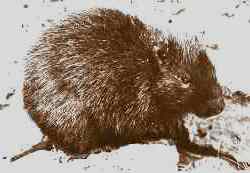
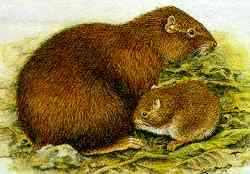
Animal Info - Cabrera's Hutia(Other Names: Conguino, Jutia)Mesocapromys angelcabrerai (Capromys a.)Status: Critically EndangeredContents1. Profile (Picture) ProfilePictures: Related Species: Bahamas Hutia (7 Kb JPEG) and Jamaican Hutia (8 Kb JPEG) Cabrera's hutia is found in mangrove forests.
Its diet generally includes leaves, bark, fruit, lizards and other small animals.
Cabrera's hutia is mainly arboreal. The communal
nests it reportedly builds in mangrove trees are circular, measuring about 1 m (3.3') in
diameter, and are built out of mangrove branches and leaves. Status and TrendsIUCN Status:Countries Where Cabrera's Hutia Is Currently Found:2004: Occurs in Cuba (IUCN 2004). History of Distribution:It is known only from a few specimens collected in the mid-1970's on the islands of the Cayos de Ana Maria, off south-central Cuba. Distribution Map (12 Kb) (InfoNatura) Threats and Reasons for Decline:Cabrera's hutia is very localized but is abundant in the areas where it occurs. The area is remote and there are no plans for development (Alvarez & Gonzalez 1991). Data on Biology and EcologyHabitat:
Diet:
Behavior:
Social Organization:
ReferencesAlvarez & Gonzalez 1991, Burton & Pearson 1987, Cons. Intl., InfoNatura, IUCN 1994, IUCN 1996, IUCN 2000, IUCN 2003a, IUCN 2004, Nowak 1999, Nowak & Paradiso 1983, Olson & Dinerstein 1998, Olson & Dinerstein 1999 Top of Page | Search This Site Home | Rarest Mammals | Species Index | Species Groups Index | Country Index | Links Last modified: August 1, 2006; |
|
© 1999 - 2019
Animal
Info. Endangered animals of the
world.
Contact Us.. |