|
|

|
|
|
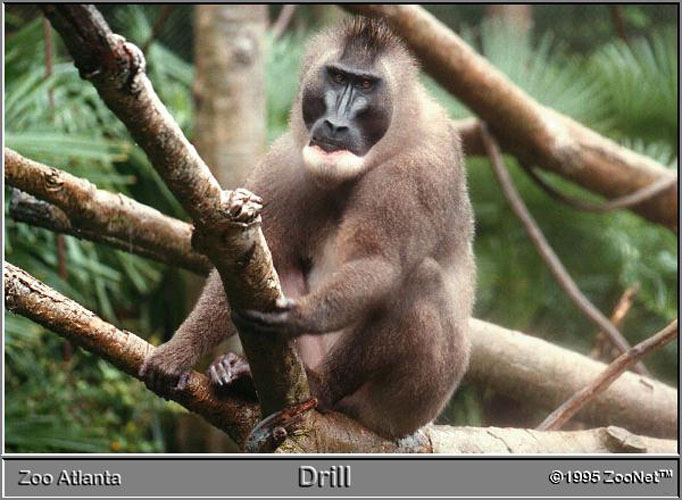
Animal Info - Drill(Other Name: Dril)Mandrillus leucophaeus (Papio l.)Status: EndangeredContents1. Profile (Picture) ProfilePictures: Drill #1 (7 Kb JPEG) (Kids Ecology Corps); Drill #2 (32 Kb JPEG) (Spec. Cons. Found.); Drill #3 (91 Kb JPEG) The drill is a short-tailed forest baboon weighing about 15 kg (33 lb). It is found in
tropical rain forest, where it subsists on a diet of fruit, seeds, fungi, roots, insects
and small animals. The drill is semi-terrestrial,
feeding mainly on the ground. Tidbits*** In 1995 the IUCN rated the drill as the highest conservation priority among African primates with regard to species vulnerability and habitat value (Gadsby 1995). *** Hunters report that it is declining in terms of group size and group density, and super-groups are rarely encountered (Gadsby 1995). *** Other than in Korup National Park in Cameroon, there were no studies of the drill undertaken between the late 1960's and the late 1980's. Status and TrendsIUCN Status:
Countries Where the Drill Is Currently Found:2004: Occurs in Cameroon, Equatorial Guinea (Bioko) and Nigeria. May occur in Gabon. (IUCN 2004) Population Estimates:
History of Distribution:Even as of 1996 the distribution of the drill was still uncertain, but it appeared to be restricted to a range of less than 40,000 sq km in western Cameroon, southeastern Nigeria and Bioko Island (Equatorial Guinea). It may occur in Gabon (IUCN 2004). Distribution
Map #1
(14 Kb GIF) (African Mammals
Databank 2004) Threats and Reasons for Decline:The major reasons for the drill's decline are hunting for food and habitat loss and fragmentation due to development, logging and agriculture. Data on Biology and EcologyWeight:
Habitat:
Age to Maturity:
Gestation Period:
Birth Season:
Birth Rate:
Maximum Age:
Diet:
Behavior:
Social Organization:
Mortality and Survival:
Density and Range:
ReferencesAfrican Mammals Databank 2004, Arkive, AZA 1999, Burton & Pearson 1987, Cons. Intl. 2005, Fa et al. 1995, Gadsby 1995, Harrison 1988b, IUCN 1994, IUCN 1996, IUCN 2000, IUCN 2003a, IUCN 2004, Kids Ecology Corps, Nowak & Paradiso 1983, Oates 1996, Olson & Dinerstein 1998, Olson & Dinerstein 1999, Slade et al. 1998, Spec. Cons. Found., Top of Page | Search This Site Home | Rarest Mammals | Species Index | Species Groups Index | Country Index | Links Last modified: August 1, 2006; |
|
© 1999 - 2019
Animal
Info. Endangered animals of the
world.
Contact Us.. |