|
|

|
|
|
Animal Info - Preuss's Monkey(Other Names: Mono de Preuss, Preuss's Guenon, Preuß-Bartmeerkatze)Cercopithecus preussi (C. lhoesti preussi)Status: EndangeredContents1. Profile (Picture) ProfilePictures: Preuss's Monkey #1 (7 Kb JPEG) (Bioko Biodiv. Prot. Prog.); Preuss's Monkey #2 (juvenile female) (173 Kb GIF) and Preuss's Monkey #3 (infant female in threat pose) (204 Kb GIF) (Prim. Info Net) Preuss's monkey is a darkish monkey with a white chin weighing up to 10 kg (22 lb).
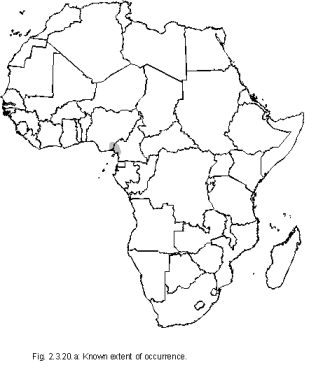
Although sometimes found in lowland forest, it is most common in montane forest up to 2500 m (8200'). It is terrestrial and eats fruit, leaves and insects. Preuss's monkey is found in western Cameroon, eastern Nigeria and on the island of Bioko (Fernando Po) in Equatorial Guinea. It is threatened by habitat loss and hunting. Tidbits*** Preuss's monkey occasionally raids crops. Status and TrendsIUCN Status:
Countries Where Preuss's Monkey Is Currently Found:2004: Occurs in Cameroon, Equatorial Guinea (Bioko) and Nigeria. (IUCN 2004) History of Distribution:Preuss's monkey is found in western Cameroon, eastern Nigeria and on the island of Bioko (Fernando Po) in Equatorial Guinea. Distribution Map (14 Kb GIF) (African Mammals Databank 2004) Threats and Reasons for Decline:Threats include habitat loss and hunting. Data on Biology and EcologyWeight:
Habitat:
Age to Maturity:
Birth Rate:
Maximum Age:
Diet:
Behavior:
Social Organization:
Mortality and Survival:
Density and Range:
ReferencesAfrican Mammals Databank 2004, Bioko Biodiv. Prot. Prog., Burton & Pearson 1987, Cons. Intl. 2005, Fa et al. 1995, IUCN 1994, IUCN 1996, IUCN 2000, IUCN 2003a, IUCN 2004, Macdonald 1984, Oates 1996, Prim. Info Net, Slade et al. 1998 Top of Page | Search This Site Home | Rarest Mammals | Species Index | Species Groups Index | Country Index | Links Last modified: March 14, 2005; |
|
© 1999 - 2019
Animal
Info. Endangered animals of the
world.
Contact Us.. |