|
|

|
|
|
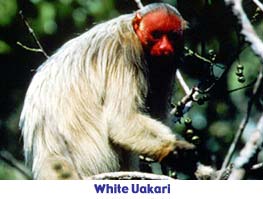
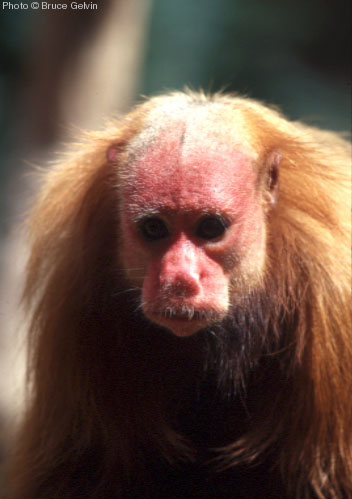
Animal Info - Red Uakari(Other Names: Bald Uakari, Bald-headed Uakari, Cacajao, Cacayao, English Monkey, Huapo Colorado, Huapo Rojo, Ouakari Chauve, Red-and-white Uacari, White Bald-headed Uacari, White Uakari, Uacari, Uacaries)Cacajao calvus (Includes C. rubicundus)Contents1. Profile (Picture) ProfilePictures: White Uakari subspecies (15 Kb JPEG); Red Uakari subspecies (31 Kb JPEG) The red uakari is a medium-sized monkey weighing about 4 kg (9 lb). The swamp forests
that it lives in are periodically flooded. Uakaris are diurnal
and are often found in the tops of large trees. Most of the uakari's diet consists of
fruit, but leaves, seeds, insects and small animals are also consumed. Troops of uakaris
have been reported to include up to 50 individuals. They usually forage for food in much
smaller groups but rejoin the troop to sleep. One young is born every 2 years. Tidbits*** Uakaris eat the same food as other medium-sized monkeys. However, uakaris are the only monkeys of their type to occupy flooded swamp forest habitat. *** Hunting is not a serious problem for the subspecies C. c. calvus because human population density in its habitat is low, and because most residents don't eat them, considering them to be either too ugly or too human (Ayres & Johns 1987). *** Surveys of unlogged and logged varzeas in the middle 1980's indicated that moderate levels of logging apparently did not result in population reduction or reduce breeding of the subspecies C. c. calvus (Ayres & Johns 1987). Status and TrendsIUCN Status:
Countries Where the Red Uakari Is Currently Found:2004: Occurs in Brazil, Colombia and Peru (IUCN 2004). History of Distribution:In 1966, the red uakari was known to occur between the Amazon and the Putumay Rivers in western Brazil and eastern Peru (C.c. rubicundus) and in the region between the Amazon and Japura Rivers in western Brazil (C. c. calvus). As of 1984, C. c. rubicundus was known to occur north of the Amazon River from Rio Japura (Brazil) west to the Andean foothills; and south of the Amazon River from Rio Jurua (Brazil) to Rio Huallaga (Peru). As of 1987 C. c. calvus was known to occur only in varzea habitat in a small area between the Japura and Solimoes Rivers (Brazil). Up to the late 1980's, this species thought to include two subspecies, C. c. rubicundus and C.c. calvus. Subsequently, two additional subspecies were identified. C. c. novaesi was thought to occur between the Biru and Tarauca Rivers, and C. c. ucayalii was thought to occur between the Ucayali and Solimoes Rivers. Currently the red uakari is thought to occur in Brazil, Colombia and Peru. Distribution
Map #1 (18 Kb) (InfoNatura) Threats and Reasons for Decline:Reasons for the decline of the red uakari include hunting for food and trapping for pets and the export trade (C. c. rubicundus) and deforestation of its habitat for lumber (C. c. calvus). Data on Biology and EcologyWeight:
Habitat:
Age to Maturity:
Birth Season:
Birth Rate:
Maximum Reproductive Age:
Maximum Age:
Diet:
Behavior:
Social Organization:
Density and Range:
ReferencesAyres & Johns 1987, Bodmer et al. 1997, Burton & Pearson 1987, Curry-Lindahl 1972, InfoNatura, Inst. Ciên. Biol., IUCN 1967, IUCN 1994, IUCN 1996, IUCN 2000, IUCN 2003a, IUCN 2004, Macdonald 1984, Nowak & Paradiso 1983, Olson & Dinerstein 1998, Olson & Dinerstein 1999, WCS Flooded Forest Top of Page | Search This Site Home | Rarest Mammals | Species Index | Species Groups Index | Country Index | Links Last modified: September 9, 2006; |
|
© 1999 - 2019
Animal
Info. Endangered animals of the
world.
Contact Us.. |