|
|

|
|
|
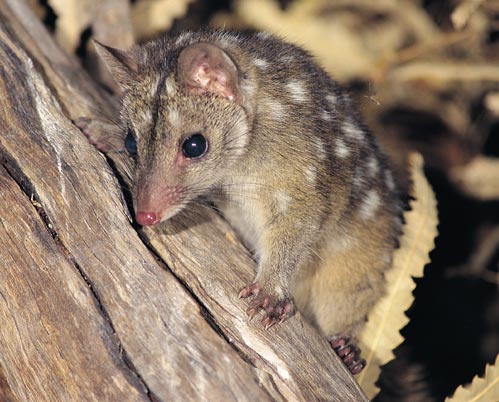
Animal Info - Western Native Cat(Other Names: Chuditch, Western Quoll)Dasyurus geoffroii (Dasyurinus geoffroyi geoffroyi)Status: VulnerableContents1. Profile (Picture) ProfilePictures: Western Native Cat #1 (25 Kb JPEG) (Mus. Vict.); Western Native Cat #2 (50 Kb JPEG) (Austral. Wildl. Cons.) The western native cat is a nocturnal marsupial,
although it is most active around dawn and dusk. Its preferred habitat is open savanna, dry forest and woodland. It can climb well, and
usually spends the day in a tree hollow or a burrow dug by itself or another species. Its
diet consists of insects and small vertebrates, including frogs, lizards, birds,
hopping-mice and carrion. Tidbits*** This carnivorous marsupial can maintain its body temperatures and normal activity can continue even when the outside temperature is 0 deg C (32 deg F). *** The western native cat doesn't lose much body water, even if high environmental temperatures are encountered. It appears to get sufficient fluid without drinking if it is on a diet of fresh meat. *** In settled areas it will raid poultry runs and rubbish bins. Status and TrendsIUCN Status:
Countries Where the Western Native Cat Is Currently Found:2004: Occurs in Australia (Western Australia). (IUCN 2004) Population Estimates:
History of Distribution:The former range of the western native cat extended from Victoria and South Australia through New South Wales to Queensland but apparently did not include the coast region of the southeast or the extreme north. In the 19th century it was known from the center, west and northwest of New South Wales, and the south central and southwest parts of Queensland. In the Northern Territory it was known from Barrow Creek, Crown Point and Alice Springs, and was common to the south of Hooker Creek. It was also known south of a line from Shark Bay to Rawlinna in Western Australia. By 1966, it was doubtful that it survived in New South Wales or Queensland, but it was thought that there might be a surviving remnant in central Australia. By 1983, it continued to decline severely and was thought to survive only in remote parts of southwestern Western Australia, central Australia and Queensland. In 1987, it was thought to survive in Western Australia. During the 1980's it was thought to have lived in Papua New Guinea, but the specimens from New Guinea were determined to be a different species. In 1992 it was reported to be restricted to the southwest of Western Australia below 31 deg South, with the main known populations in the jarrah forest with isolated populations in, and to the east of the wheatbelt. Threats and Reasons for Decline:The decline of the western native cat in desert areas was probably related to the changing fire regimes and introduced predators, while the decline in the more mesic southwest of Western Australia was probably related to the loss of large areas of natural vegetation and introduced predators. Data on Biology and EcologyWeight:
Habitat:
Age to Maturity:
Gestation Period:
Birth Season:
Birth Rate:
Early Development:
Maximum Age:
Diet:
ReferencesAustral. Wildl. Cons., Burbidge & McKenzie 1989, Burton & Pearson 1987, Cons.
Intl. 2005, Flannery 1990, IUCN 1966,
IUCN 1994, IUCN 1996, IUCN 2000, IUCN 2003a,
IUCN 2004, Kennedy 1992,
Mus. Vict., Nowak & Paradiso 1983 Top of Page | Search This Site Home | Rarest Mammals | Species Index | Species Groups Index | Country Index | Links Last modified: June 2, 2006; |
|
© 1999 - 2019
Animal
Info. Endangered animals of the
world.
Contact Us.. |