|
|

|
|
|
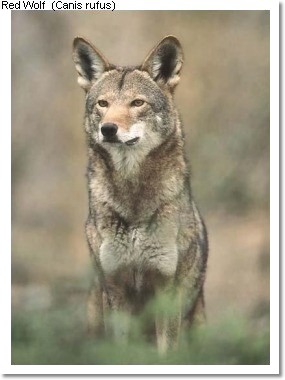
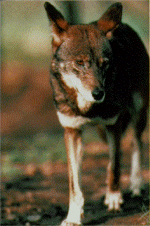
Animal Info - Red WolfCanis rufus (C. niger)Status: Critically EndangeredContents1. Profile (Picture) ProfilePictures: Red Wolf #1 (29 Kb JPEG) (Lioncrusher); Red Wolf #2 (35 Kb GIF); Red Wolf #3 (109 Kb JPEG) (Smithson. Inst.) The coat of the red wolf is tawny-cinnamon mixed with gray and black, and is darkest on the back. Red wolves have a head and body length of 1 - 1.2 m (3.25 - 4') and a weight of 18 - 41 kg (40 - 90 lb). Given their wide historical distribution, red wolves probably utilized a large suite of habitat types at one time. The species was apparently most numerous in the once extensive bottomland river forests and swamps of the southeastern USA. Red wolves re-introduced into northeastern North Carolina have made extensive use of habitat types ranging from agricultural lands to forest/wetland mosaics. In the past, the red wolf had been reported to eat animals up to the size of small deer, including pigs; raccoons; muskrats, nutria, and other rodents; and rabbits. It will also eat carrion. Analysis of scat of the current, re-introduced wild population of red wolves indicates that white-tailed deer, raccoon and marsh rabbits are primary year-round food items. Red wolf cubs are born in dens, which can be located in the trunks of hollow trees, stream banks or sand knolls. The dens are either excavated by the wolves or taken over from another animal. The red wolf is primarily nocturnal, but it may increase its daytime activity during the winter. The red wolf is a pack-living animal with a complex social organization, similar to that of the gray wolf. Packs are primarily family groups led by a mated, territorial pair. The red wolf's historic range is now thought not only to have included the southeastern USA but also to have extended further north into the northeastern USA and extreme eastern Canada. The red wolf was formerly abundant over the southeastern USA as far west as east-central Texas. By the 1930's it had been extirpated east of the Mississippi. By the 1960's only small populations remained in the coastal areas of southeast Texas and southwest Louisiana. In the middle 1970's, all remaining wild animals were captured and a captive breeding program was initiated. The species was extinct in the wild by 1980. Red wolves raised in the captive breeding program were re-introduced into eastern North Carolina in 1987. Presently, red wolves exist only in a re-introduced population in an area of roughly 6000 sq km (2300 sq mi) on the peninsula in eastern North Carolina between Albemarle and Pamlico Sounds. Reasons for the red wolf's decline included hunting, poisoning and trapping (because it was perceived as a threat to livestock, and possibly to people), habitat disruption, and competition and hybridization with the coyote. Hybridization with coyotes, which became well established in northeastern North Carolina during the 1990s, is the primary threat to the current wild species' existence. Tidbits*** The red wolf is one of the world's rarest mammals. *** There was apparently little overlap between the gray wolf, which inhabited all other areas of the United States outside of the red wolf's range, and the smaller red wolf. Status and TrendsIUCN Status:
Countries Where the Red Wolf Is Currently Found:2004: Occurs in re-introduced populations in the USA. May occur in Canada. (IUCN 2004) Population Estimates:
History of Distribution:At one time, the red wolf’s historical distribution was believed to have been limited to the southeastern USA - from Florida to east-central Texas, including southeastern Tennessee, Alabama, and most of Georgia and Florida, and as far north as southern Illinois. On the basis of further study, its historic range is now thought to have extended further north into the northeastern USA and extreme eastern Canada. Recent genetic evidence supports a similar but even greater extension of historic range into the Algonquin Provincial Park in southern Ontario, Canada. The red wolf was formerly abundant over the southeastern USA as far west as east-central Texas. By the 1930's it had been extirpated east of the Mississippi River. By the 1960's only small populations remained in the coastal areas of southeast Texas and southwest Louisiana. In the middle 1970's, all remaining wild animals were captured and a captive breeding program was initiated to help preserve the species. The species was extinct in the wild by 1980. Red wolves raised in the captive breeding program, starting with 17 red wolves captured in Texas and Louisiana, were re-introduced into eastern North Carolina in 1987. The current re-introduced population of red wolves occupies an area of roughly 6000 sq km (2300 sq mi) on the peninsula in eastern North Carolina between Albemarle and Pamlico Sounds. This area is comprised of 60% private land and 40% public land and contains three national wildlife refuges. From 1991 - 1998 a second re-introduction project was conducted at the Great Smoky Mountains National Park, Tennessee. However, the project was terminated, mainly due to a high pup mortality, which was suspected to be caused by disease, predation, malnutrition, and parasites. Distribution
Map #1 (former distribution) (2 Kb GIF) (Lioncrusher) Threats and Reasons for Decline:Reasons for its decline included hunting, poisoning and trapping (because it was perceived as a threat to livestock, and possibly to people), habitat disruption, and competition and hybridization with the coyote. Hybridization with coyotes, which became well established in northeastern North Carolina during the 1990s, is the primary threat to the current wild species' existence (IUCN 2004). Data on Biology and EcologySize and Weight:
Habitat:
Age to Maturity:
Gestation Period:
Birth Season:
Birth Rate:
Early Development:
Maximum Age:
Diet:
Behavior:
Social Organization:
Mortality and Survival:
Density and Range:
ReferencesArkive, Brownlow 1996, Burnie & Wilson 2001, Burton & Pearson 1987, Curry-Lindahl 1972, Fitter 1974, Ginsberg & Macdonald 1990, Hummer & Pettigrew 1991, IUCN 1970, IUCN 1994, IUCN 1996, IUCN 2000, IUCN 2003a, IUCN 2004, Lioncrusher, Nowak & Paradiso 1983, Oryx 1988e, Oryx 1989f, Oryx 1991e, Phillips 1995, Primack 1993, Smithson. Inst. Top of Page | Search This Site Home | Rarest Mammals | Species Index | Species Groups Index | Country Index | Links Last modified: January 26, 2005; |
|
© 1999 - 2019
Animal
Info. Endangered animals of the
world.
Contact Us.. |