|
|

|
|
|
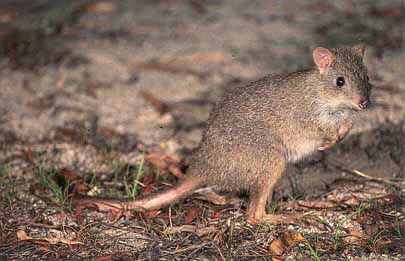
Animal Info - Northern Bettong(Other Names: Northern Rat Kangaroo)Bettongia tropica (May be included in B. penicillata)Status: EndangeredContents1. Profile (Picture) ProfilePictures: Northern Bettong #1 (24 Kb JPEG); Northern Bettong #2 (25 Kb GIF) (James Cook Univ. 2002) The northern bettong, a marsupial, is a small
kangaroo weighing about 1 kg (2.2 lb). It prefers tall open forest and grassy woodland,
generally above 400m (1300') elevation. Fruiting
bodies of fungi (similar to truffles) are the most important food item. The northern
bettong is nocturnal. It may require considerable
movement during the night to locate the widely scattered fungi it prefers for food. It
spends the day hidden in a nest on the ground, located within concealing vegetation or
litter. The northern bettong is usually solitary. Tidbits*** In the area of tropical Queensland, Australia, where the northern bettong occurs, local governments are guiding residential development into areas with infertile soils, to avoid the loss of productive agricultural land. Normally this policy would seem logical. However, from the standpoint of the northern bettong, it's the wrong policy - the fungus it feeds on is most abundant in infertile soils. (Laurance 1997) Status and TrendsIUCN Status:
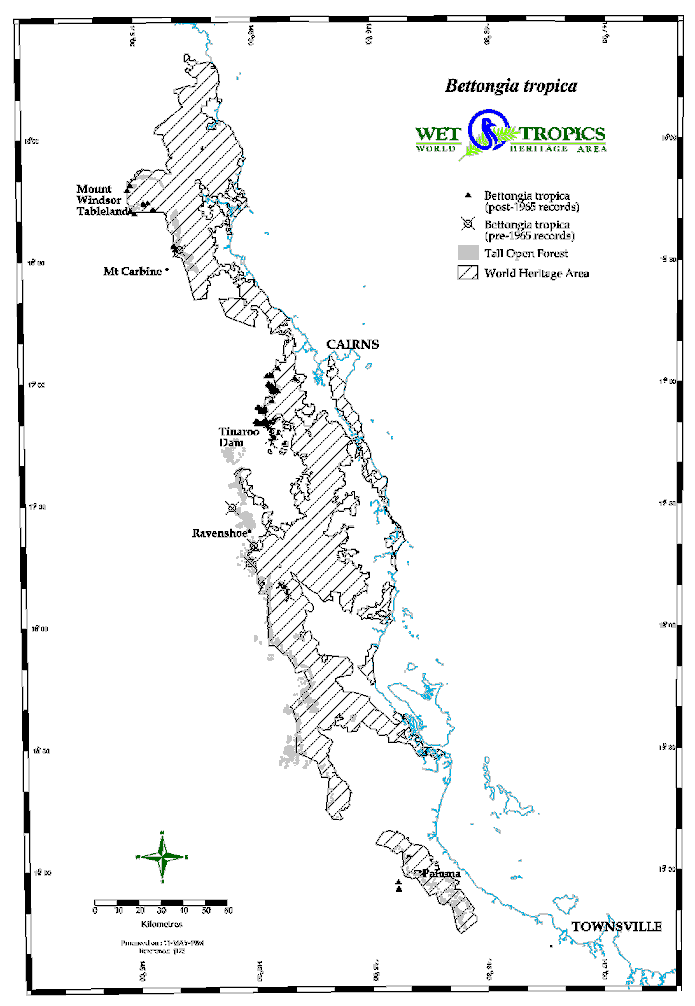
Countries Where the Northern Bettong Is Currently Found:2004: Occurs in Australia (Queensland) (IUCN 2004). History of Distribution:Its original distribution is not known. Previously it been observed in the Dawson Valley area in central coastal Queensland (1884) and near Ravenshoe (possibly as late as the 1920's). Until recently, it had been known from only six specimens, the latest collected in 1932, and was thought possibly to be extinct, but a population was discovered in the late 1970's in northern Queensland, Australia. As of 1996 its known range was restricted to three small isolated populations in northern Queensland within 80 km (50 mi) of one another: in the Lamb Range (where a survey in 1994-95 found it to be present in nearly half of the live-trapping sites surveyed (Laurance 1997)) and in the areas of Mt. Windsor and Carbine Tableland (Maxwell et al. 1996). Distribution
Map (4 Kb GIF) (Maxwell et al. 1996) Threats and Reasons for Decline:It has been proposed that the decline of non-flying Australian mammals with a weight
such as the northern bettong's has been caused by environmental changes since European
settlement which have emulated an increase in aridity by reducing the environmental
productivity available to vertebrates. These include the diversion of environmental
resources to humans and introduced species, and a reduction in vegetative cover by exotic
herbivores and changed fire regimes (Burbidge &
McKenzie 1989). Data on Biology and EcologyWeight:
Habitat:
Birth Season:
Early Development:
Diet:
Behavior:
Social Organization:
ReferencesBurbidge & McKenzie 1989, Envir. Australia 2002, IUCN 1994, IUCN 1996, IUCN 2000, IUCN 2003a, IUCN 2004, James Cook Univ. 2002, Kennedy 1992, Laurance 1997, Maxwell et al. 1996, Nowak & Paradiso 1983, Vernes & Pope 1996 Top of Page | Search This Site Home | Rarest Mammals | Species Index | Species Groups Index | Country Index | Links Last modified: May 31, 2005; |
|
© 1999 - 2019
Animal
Info. Endangered animals of the
world.
Contact Us.. |