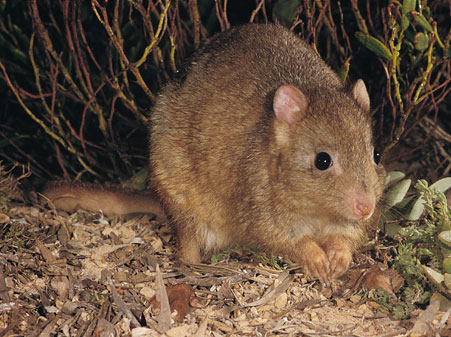
Animal Info - Burrowing Bettong
(Other Names: Bettongie de Lesueur, Boodie,
Burrowing or Short--nosed Rat Kangaroo, Canguro-rata de Lesueur, Kangourou-rat de Lesueur,
Lesueur's Rat Kangaroo, Tungoo)
Bettongia lesueur (B. lesueuri)
Contents
1. Profile (Picture)
2. Tidbits
3. Status and Trends (IUCN Status, Countries Where
Currently Found, Population Estimates, History of Distribution, Threats and Reasons
for Decline)
4. Data on Biology and Ecology (Weight, Habitat, Age to Maturity, Gestation
Period, Birth Season, Birth Rate, Early Development, Diet, Behavior,
Social Organization)
5. References
Profile
Pictures: Burrowing
Bettong #1 (28 Kb JPEG) (Milamba
Aust.); Burrowing
Bettong #2 (62 Kb JPEG) (Aust.
Wildl. Cons.)
The burrowing bettong, a marsupial, is a stocky
member of the kangaroo family. It is strictly nocturnal
and is largely vegetarian. It occupies a broad range of habitats from spinifex deserts to woodlands and lives in burrows,
which it digs itself. One of these burrows may house more than 50 individuals. Formerly
one of the most common and widespread native mammals in Australia,
it survives only on three islands off the coast of Western Australia.
This bettong originally occurred in all mainland states, except perhaps Queensland.
It had disappeared from Victoria and New South Wales by the 1860's but remained common in
parts of central and southwestern Australia until the 1930's. By 1966 it appeared to be
virtually extinct over most of its former range, with remnant pockets possibly remaining
in northwestern and central Australia. By 1992 it occurred only on Barrow, Dorre and
Bernier Islands off of Western Australia;
Many factors have been proposed as possible causes of its decline, including the general
diversion of environmental resources to humans and introduced species, a reduction in
vegetative cover by introduced herbivores and changed fire regimes, predation by
introduced foxes, direct killing by people, predation by cats (particularly on islands),
competition from rabbits, and competition from black rats on Boodie Island.
Tidbits
*** The burrowing bettong is the only burrowing species of the kangaroo family.
*** It uses scent to locate its food, which it then digs out of the ground.
*** In the 19th century it was considered a destructive pest of settlers' gardens.
Status and Trends
- 1960's: Insufficiently Known
- 1970's - 1980's: Rare
- 1994: Endangered
- 1996 - 2004: Vulnerable (Criteria: D2) (Population Trend: Decreasing)
(IUCN 2004)
Countries Where the Burrowing Bettong Is Currently Found:
2004: Occurs in Australia (IUCN
2004).
Population Estimates:
[Note: Figures given are for wild populations only.]
- Australia
- Barrow Island
- Bernier Island
- Dorre Island
History of Distribution:
This bettong had one of the most extensive continental ranges of any of the Australian marsupials, originally occurring in all
mainland states except perhaps Queensland over the region from about 14 degrees South in
the northwest down to the extremity of the southeast coast (37 degrees 50 minutes South),
and from the west coast almost across to the Great Dividing Range in New South Wales. It
had disappeared from Victoria and New South Wales by the 1860's. It remained common in
parts of central and southwestern Australia until the 1930's. By 1966 it appeared to be
virtually extinct over most of its former range, with remnant pockets possibly remaining
in northwestern and central Australia. It was common on Bernier and Dorre Islands. By 1987
it occurred only on Barrow, Boodie, Dorre and Bernier Islands off of Western Australia; by
1992 had become extinct on Boodie Island.
Threats and Reasons for Decline:
Proposed factors leading to its overall decline include the general diversion of
environmental resources to humans and introduced species, a reduction in vegetative cover
by introduced herbivores and changed fire regimes, predation by introduced foxes, direct
killing by people, predation by cats (particularly on islands), competition from rabbits,
and competition from black rats on Boodie Island.
Data on Biology and Ecology
The burrowing bettong weighs about 2 kg (4.4 lb) but can be lighter in some areas.
Habitat:
On the mainland, habitats ranged from open eucalypt or acacia woodland with a grass and
shrub understory to sandridge desert covered with spinifex
hummocks and sparse shrubs. In island habitats the vegetation cover consists of a variety
of shrubs, herbs and grasses.
The burrowing bettong is one of the species that live in the Southwest
Australia Biodiversity
Hotspot (Cons.
Intl.).
Age to Maturity:
Sexual maturity is attained within a year. Females apparently are capable of giving
birth when about 200 days old.
Undelayed gestation is about 21 days. (But see Birth Rate
below.)
Birth Season:
A female burrowing bettong can produce up to three litters per year. Breeding may
go on throughout the year in some areas, but in the Bernier Island population most births
occur between February and September.
Birth Rate:
The usual litter size is one, though twins occasionally occur.
Just after one young is born the female mates again, but because of embryonic diapause development is delayed, and
the second young is not born for about four months, unless the first young is lost.
Early Development:
The young leaves the pouch at about 115 days after birth but is not weaned for a
further 3-10 weeks.
Diet:
It mainly consumes tubers, bulbs, seed nuts and the green parts of plants. Some
communities have been known to eat fungi, termites and marine refuse, as well as to raid
vegetable gardens.
Behavior:
The burrowing bettong is strictly nocturnal.
Social Organization:
A male and several females form a social group and occupy a burrow. The burrow may be a
simple structure with only 1-2 entrances and a short tunnel, or a large warren with more
than 100 entrances. One of these warrens may house more than 50 individuals. Males are
aggressive toward one another, and seem to defend groups of females but not a particular
territory. Females generally are amicable, but sometimes will establish a territory and
exclude other females.
References
Aust. Wildl. Cons., Burbidge & McKenzie 1989, Burton & Pearson 1987, Cons.
Intl., Earth
Sanct, Flannery 1990, IUCN 1966,
IUCN 1994, IUCN 1996, IUCN 2000, IUCN
2003a, IUCN 2004,
Kennedy 1992,
Maxwell et al. 1996, Milamba
Aust. ,Nowak
& Paradiso 1983, Short & Turner 1994
Top of Page | Search
This Site
Home | Rarest Mammals
| Species Index | Species Groups
Index | Country Index | Links
Last modified: June 2, 2006;
|