|
|

|
|
|
Animal Info - Gray Bat(Other Names: Gray Myotis, Howell's Bat)Myotis grisescensStatus: EndangeredContents1. Profile (Picture) ProfilePictures: Gray Bat #1 (92 Kb JPEG) (Smith. Inst. N. Amer. Mamm.); Gray Bat #2 (85 Kb JPEG) (Smith. Inst. N. Amer. Mamm.) The gray bat weighs 7 - 9 g (0.2 - 0.3 oz). Its limestone roosting caves and foraging areas are near water bodies such as streams, ponds and reservoirs. Its diet consists predominantly of insects. All species of the genus Myotis, including the gray bat, roost by day and forage at night. The feeding flights usually alternate with periods of rest, during which the bats hang to digest their catch. Colonies of the gray bat travel up to 6.6 km (4.1 mi) from roost to foraging areas. During the summer a colony occupies a definite home range and may move among 6 or more roosting caves. Large-scale movement to hibernation sites begins in September and covers 17 - 437 km (11 - 271 mi) (Nowak & Paradiso 1983). Gray bats are highly gregarious. They hibernate in large colonies in caves during the winter. In the summer, females gather in smaller colonies at other caves to give birth, while the males collect nearby After late July, the males join the maternity colonies. The gray bat occurs in the central USA. It is thought to have declined mainly due to destruction by vandals and disturbance by spelunkers and tourists. Tidbits*** Individual gray bats almost invariably return to the same caves in which they hibernate over winter and roost in summer (Altringham 1996) *** The gray bat occupies the coldest reported summer roosts in North America (down to 13 deg C (55 deg F)). Status and TrendsIUCN Status:
Countries Where the Gray Bat Is Currently Found:2004: Occurs in the USA (IUCN 2004). Population Estimates:
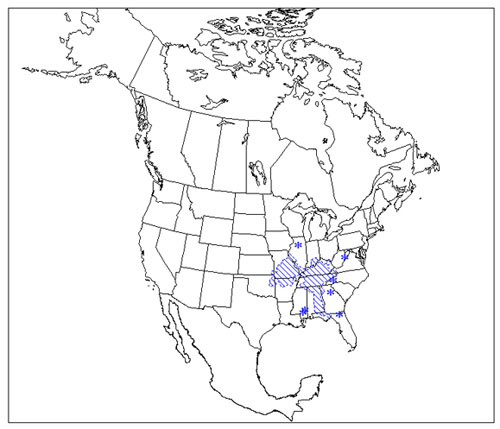
History of Distribution:The gray bat is found in the USA from eastern
Kansas and Oklahoma to western Virginia south to northwestern Florida. As of 1987,
approximately 95% of the population was estimated to hibernate in nine roosts, with one
containing more than 50% of the population (Burton
& Pearson 1987). Threats and Reasons for Decline:As of 1987 the gray bat was estimated to have declined by up to 76% from its original population (Burton & Pearson 1987). The decline has been attributed mainly to destruction by vandals and disturbance by spelunkers and tourists. Its distribution has always been patchy, but it is becoming increasingly fragmented. Data on Biology and EcologyWeight:
Habitat:
Birth Season:
Early Development:
Diet:
Social Organization:
ReferencesAltringham 1996, Bat Cons. Intl., Burton & Pearson 1987, IUCN 1994, IUCN 1996, IUCN 2000, IUCN 2003a, IUCN 2004, NatureServe Expl., Nowak & Paradiso 1983, Smith. Inst. N. Amer. Mamm., Stebbings 1980 Top of Page | Search This Site Home | Rarest Mammals | Species Index | Species Groups Index | Country Index | Links Last modified: May 17, 2006; |
|
© 1999 - 2019
Animal
Info. Endangered animals of the
world.
Contact Us.. |