|
Translate:
       
Animal Info - Pere David's Deer
(Other Names: 麋鹿, Cerf
du Père David, Ciervo del Padre David, Père David's Deer)
Elaphurus davidianus
Status: Critically
Endangered
Contents
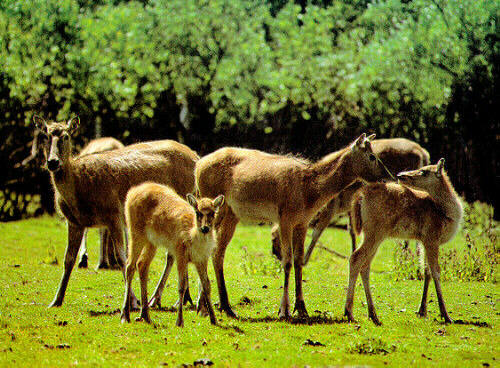
1. Profile (Picture)
2. Tidbits
3. Status and Trends (IUCN Status, Countries Where
Currently Found, Population Estimates, History of Distribution, Threats and Reasons
for Decline)
4. Data on Biology and Ecology (Weight, Habitat, Age to Maturity, Gestation
Period, Birth Season, Birth Rate, Maximum Age, Diet, Behavior)
5. References
Profile
Pictures: Pere
David's Deer #1 (15 Kb) and Pere
David's Deer #2 (70 Kb) (Les
Cerfs);
Pere David's Deer #3
(66 Kb JPEG) (Czech Web Site)
The Pere David's deer weighs 150 - 200 kg (330 - 440 lb). Its original habitat is
thought to have been swampy, reed-covered marshlands. It is a grazer, eating mainly grass which it supplements with
water plants in the summer. Unlike most deer, the Pere David's deer likes water and swims
well.
The Pere David's deer originally occurred in northeastern and east-central China, but it apparently became extinct in the wild at
least 1000 years ago. Hunting is thought to have been the main reason for the original
decline of the wild Pere David's deer. It survived in parks, and in the 1800's a French
missionary and naturalist, Father ("Pere" in French) David, observed the animals
in the last remaining Chinese herd. Word of this aroused great interest in Europe, and
subsequent efforts resulted in a number of these animals being sent to Europe. The
remaining deer in China ultimately perished in the
early 1900's, mostly due to floods and the unrest during the Boxer Rebellion. In the late
1980's, a number of deer were returned to China and re-introduced to the wild in China's
Dafeng reserve. They have successfully reproduced.
Tidbits
*** Although the species is recovering from a very small population, it appears that it
is not suffering from the serious genetic defects that can sometimes affect small
populations.
Status and Trends
Countries Where Pere David's Deer Is Currently Found:
2004: Occurs in China (re-introduced) (IUCN
2004).
Population Estimates:
[Note: Figures given are for wild populations only.]
History of Distribution:
The Pere David's deer originally occurred in northeastern and east-central China, but it apparently became extinct in the wild at
least 1000 years ago. It survived in parks, and in the 1800's a French missionary and
naturalist, Father ("Pere" in French) David, observed the animals in the last
remaining Chinese herd. Word of this aroused great interest in Europe, and subsequent
efforts resulted in a number of these animals being sent to Europe. The remaining deer in China ultimately perished in the early 1900's, mostly
due to floods and the unrest during the Boxer Rebellion. As a result, all surviving
animals descend from the captive deer sent to Europe. In the late 1980's, a number of deer
were returned to China and re-introduced to the wild in China's Dafeng reserve. They have
successfully reproduced.
Threats and Reasons for Decline:
Hunting is thought to have been the main reason for the original decline of the wild
Pere David's deer.
Data on Biology and Ecology
The Pere David's deer weighs 150 - 200 kg (330 - 440 lb).
Habitat:
The Pere David's deer's original habitat is thought to have been swampy, reed-covered
marshlands.
Age to Maturity:
About 14 months.
About 9 months.
Birth Season:
April or May.
Birth Rate:
1 or 2 fawns are born at a time.
Maximum Age:
At least 23 years (in captivity).
Diet:
The Pere David's deer is a grazer, eating mainly
grass which it supplements with water plants in the summer.
Behavior:
Unlike most deer, the Pere David's deer likes water and swims well.
References
Burton & Pearson 1987, Caughley & Gunn 1996, Curry-Lindahl 1972, Czech
Web Site, Focus
1997c, Huffman 1999, IUCN
1994, IUCN 1996, IUCN
2000, IUCN 2003a, IUCN
2004, Les Cerfs, Nowak & Paradiso 1983, Oryx 1988d, WCMC/WWF
1997
Top of Page | Search
This Site
Home | Rarest
Mammals | Species Index | Species Groups Index | Country
Index | Links
Last modified: May 30, 2005;
|